Explore our diverse research areas, groundbreaking studies and remarkable medical research achievements
Hypertrophic cardiomyopathy (HCM) is the most common inherited cardiac disease and an important cause of sudden cardiac death in youth. Although HCM is considered to be caused mainly by the pathogenic varants in genes encoding sarcomeric proteins, most commonly MYH7 and MYBPC3, more than half of patients were genetic-negative in the well-characterized disease genes.
The considerable genetic heterogeneity of HCM underscores the need to investigate novel pathogenic mechanisms and therapeutic targets, particularly those shared by different causes.
Recently, the teams of Prof. Lei Song and Prof. Shuiyun Wang at the National Clinical Research Center for Cardiovascular Diseases, Fuwai Hospital, Chinese Academy of Medical Sciences, in collaboration with Prof. Yihan Chen of Shanghai East Hospital, Tongji University, published a study entitled CRLF1 Secreted by Cardiac Fibroblasts Promotes Human Hypertrophic Cardiomyopathy in Circulation. The study reveals, for the first time, that cardiac fibroblast–derived CRLF1 is a key factor driving the development and progression of HCM across different genetic backgrounds, providing newinsigts for precision therapies and drug development.
By integrating analyses of differentially expressed genes in patients with HCM and an HCM mouse model (Myh6 R404Q/+), the researchers prioritized CRLF1 as the candidate regulator of HCM pathogenesis. The expression of CRLF1 was significantly elevated in cardiac tissues from both patients and mice with HCM, with consistent upregulation observed across multiple HCM datasets. Moreover, its expression was positively correlated with the cardiac hypertrophy markers NPPA and NPPB, suggesting a role for CRLF1 in HCM development and progression.
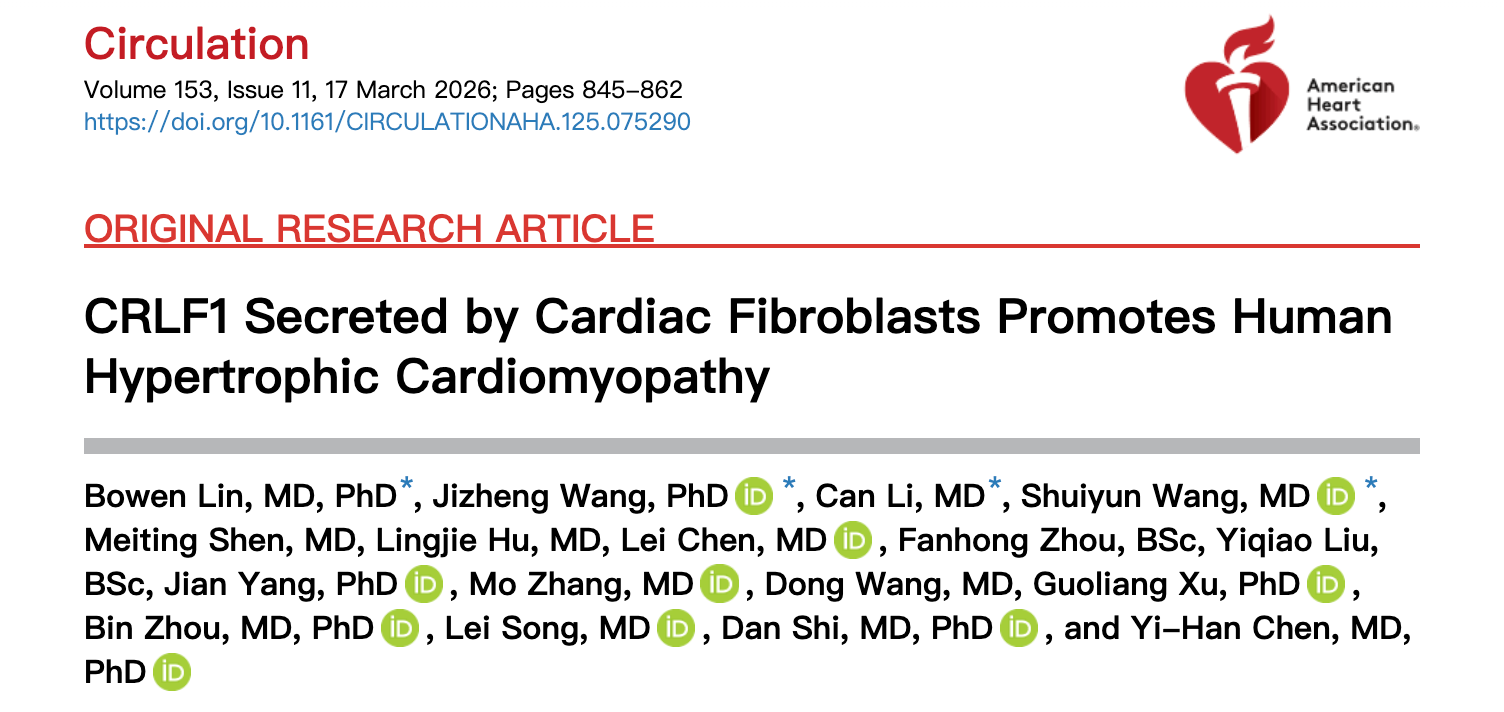
Analysis of single-nucleus RNA sequencing (snRNA-seq) datasets, together with experiments using isolated primary cardiomyocytes and fibroblasts, identified activated cardiac fibroblasts as the principal source of CRLF1. Mechanistic studies demonstrated that TGF-β activates the transcription factor KLF5, which directly binds to the CRLF1 promoter and regulates CRLF1 transcription in cardiac fibroblasts. Secreted CRLF1 acts in a paracrine manner through the leukemia inhibitory factor receptor (LIFR) on cardiomyocytes, thereby activating the downstream JAK1/2–STAT3 signaling pathway. Phosphorylated STAT3 translocates to the nucleus and regulates the expression of multiple genes, ultimately inducing cardiomyocyte hypertrophy and promoting disease progression.
To validate the pathological role of CRLF1 and assess the feasibility as a therapeutic target, the researchers conducted both gain- and loss-of-function experiments in vivo. Cardiac fibroblast–specific overexpression of CRLF1resulted in HCM phenotypes in wild-type mice. Conversely, cardiac fibroblast–specific knockdown of CRLF1 using adeno-associated virus serotype 9 (AAV9), or pharmacological blockade of downstream signaling of CRLF1 with the LIFR inhibitor EC359 or the JAK1/2 inhibitor ruxolitinib, significantly ameliorated cardiac hypertrophy in HCM mice.
In summary, this study identifies the CRLF1/LIFR–JAK1/2–STAT3 signaling axis as a novel paracrine mechanism linking cardiac fibroblasts and cardiomyocytes in HCM, establishing CRLF1 as a key molecular driver of cardiac hypertrophy. These findings reveal a shared pathological pathway across HCM with differenct causes and highlight the potential of CRLF1 and its downstream signaling components as therapeutic targets for diverse HCM subtypes.