
Explore our diverse research areas, groundbreaking studies and remarkable medical research achievements
I. Title
The BMJ | Efficacy of dual antiplatelet therapy for three months versus 12 months after coronary artery bypass grafting: multicentre, double blinded, randomised controlled trial.
II. Key Findings
The BMJ has published online a large, multicenter, randomized, double-blind, controlled clinical trial from China, "TOP-CABG," which demonstrates that in patients undergoing elective coronary artery bypass grafting (CABG), 3 months of dual antiplatelet therapy (DAPT) with ticagrelor plus aspirin is non-inferior to 12-month DAPT in terms of the 1-year saphenous vein graft occlusion rate, and significantly reduces the risk of clinically relevant bleeding. This study provides high-level evidence for an individualized antithrombotic strategy after CABG.
Original Publication:
https://www.bmj.com/content/393/bmj-2025-088939
III. Main Text
Saphenous vein graft occlusion is the major bottleneck limiting the long-term efficacy of coronary artery bypass grafting (CABG). Although dual antiplatelet therapy (DAPT) has been proven to effectively reduce the risk of occlusion, clinical practice has long faced a "balancing challenge": prolonging DAPT may maintain graft patency but significantly increases bleeding risk, whereas premature discontinuation may increase the risk of ischemic events. Currently, large randomized controlled evidence on the optimal duration of DAPT after CABG is lacking; guideline recommendations are largely extrapolated from patients undergoing percutaneous coronary intervention (PCI), and the efficacy and safety of 3-month short-course DAPT in the CABG population remain unclear. To address this gap, the present study was designed as a nationwide, multicenter, double-blind, randomized, controlled non-inferiority trial (TOP-CABG), aiming to compare the efficacy and safety of 3-month DAPT versus 12-month standard DAPT after CABG.
Methods
The study was conducted at 13 cardiac surgical centers across China and ultimately enrolled 2,290 patients undergoing elective isolated CABG with intraoperative use of saphenous vein grafts. All participants were randomized in a 1:1 ratio to the 3-month DAPT group or the 12-month DAPT group. The 3-month group received ticagrelor 90 mg twice daily plus aspirin 100 mg once daily for 3 months, after which ticagrelor was discontinued and aspirin monotherapy was continued; the 12-month group received continuous dual antiplatelet therapy throughout the 12-month period. The primary efficacy endpoint was the 1-year saphenous vein graft occlusion rate (objectively assessed by coronary CTA or angiography), and the primary safety endpoint was BARC type 2, 3, or 5 clinically relevant bleeding events.
Results
Among 2,070 patients who completed imaging evaluation (comprising 5,125 saphenous vein graft segments), the saphenous vein graft occlusion rate was 10.8% in the 3-month DAPT group and 11.2% in the 12-month group, with an absolute difference of -0.31% (95% CI -3.13% to 2.52%, non-inferiority P = 0.008), meeting the non-inferiority hypothesis. Meanwhile, the incidence of BARC type 2/3/5 bleeding was only 8.3% in the 3-month group, significantly lower than 13.2% in the 12-month group, representing an approximately 38% relative risk reduction and meeting the superiority hypothesis. A prespecified landmark analysis further revealed that the between-group difference in bleeding risk emerged significantly after postoperative day 90, whereas bleeding rates were similar within the first 90 days. This suggests that the reduction in bleeding risk may be driven by the intervention.
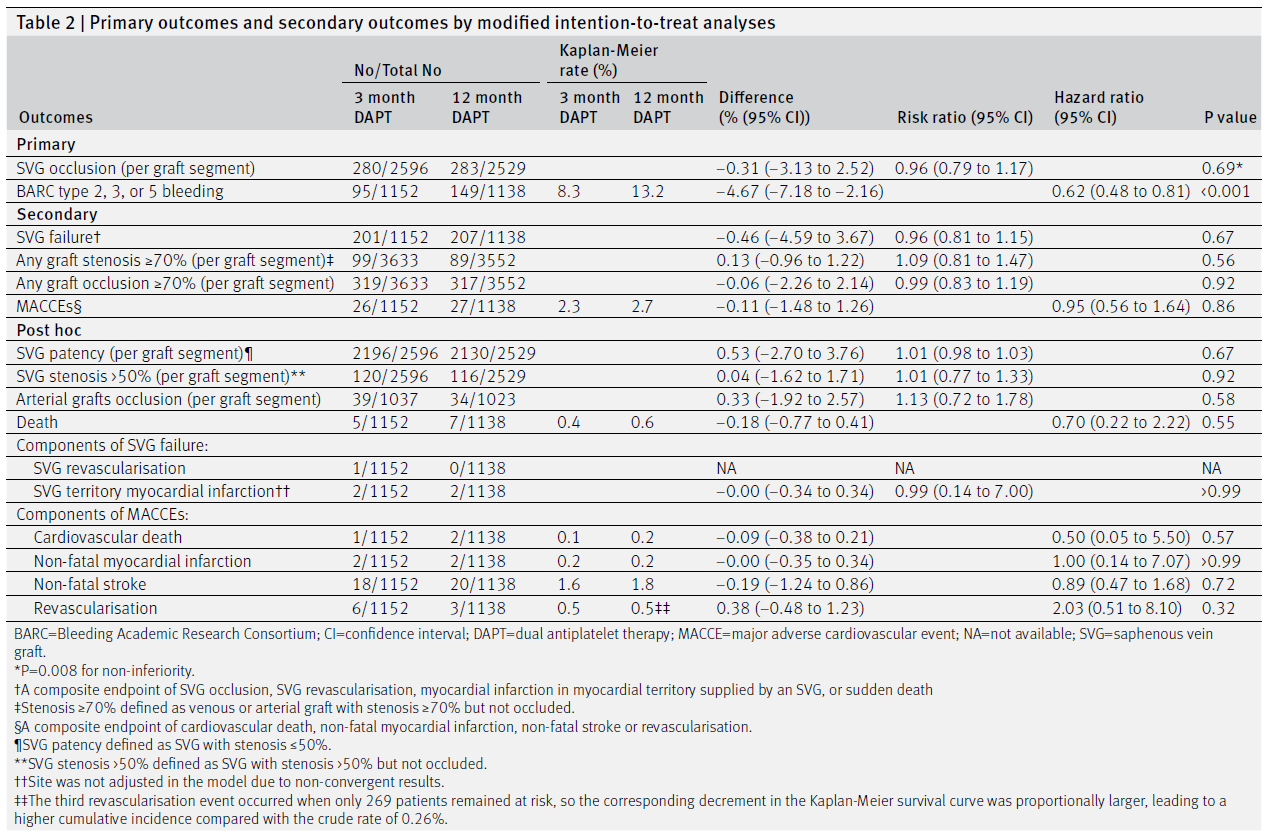
(Primary and secondary endpoint results in the mITT analysis set)
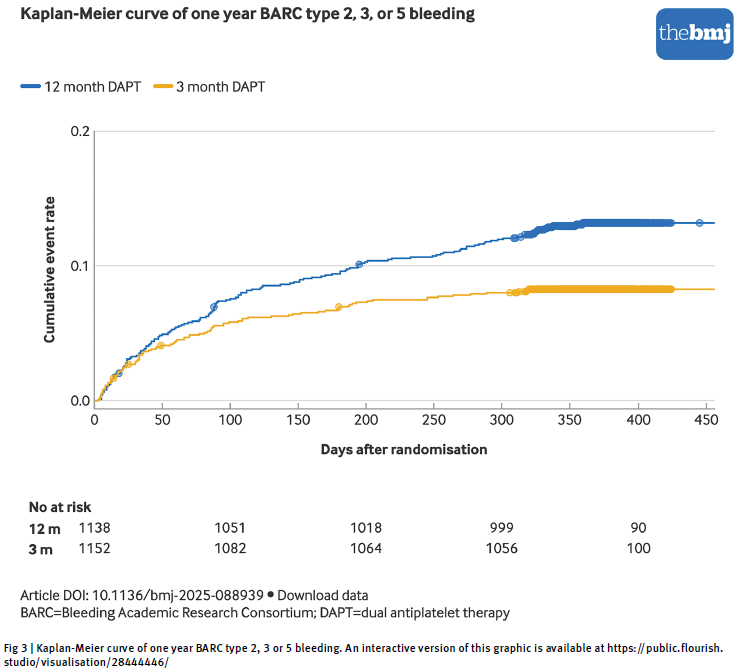
(Kaplan–Meier curve for BARC type 2, 3, or 5 clinically relevant bleeding events)
Conclusion
In summary, for patients undergoing elective CABG who can tolerate early DAPT, 3-month postoperative DAPT is safe and effective. Without increasing ischemic risk, this regimen significantly improves the safety benefit for patients and avoids unnecessary long-term bleeding risk. Future studies should further validate the long-term benefit of this strategy in populations at high bleeding or high ischemic risk.
IV. Author Information
Xin Yuan, Jingkuo Li, Lubi Lei, and Lihua Zhang from Fuwai Hospital, Chinese Academy of Medical Sciences, are co-first authors of the paper; Shengshou Hu from Fuwai Hospital, Chinese Academy of Medical Sciences, is the corresponding author.

