
Explore our diverse research areas, groundbreaking studies and remarkable medical research achievements
On June 16, 2026, the research team led by Professor Qianben Wang at the Institute of Basic Medical Sciences, Chinese Academy of Medical Sciences, in collaboration with the teams of Professor Wei Li at the University of California, Irvine, and Professor Yizhou Dong at the Icahn School of Medicine at Mount Sinai, published a research article entitled “Programmable mRNA 3′UTReEngineeringrRestores MHC-I andoOvercomesiImmuneeEvasion inpProstatecCancer” in Nature Biomedical Engineering. The study uncovers a previously underappreciated mechanism by which tumor cells evade immune recognition through aberrant shortening of mRNA 3′ untranslated regions (3′UTRs) and develops a programmable mRNA 3′UTR engineering strategy, providing a new RNA-targeting approach to enhanceresponses to immunotherapyimmunotherapeutic responses in prostate cancer.
Prostate cancer is generally considered an immunologically “cold” tumor and responds poorly to immune checkpoint therapy. One important reason is the reduced expression of major histocompatibility complex class I (MHC-I) molecules on the surface of tumor cells. MHC-I molecules function like “identification tags”,displaying protein fragments from inside the cell to the immune system.that allow tumor cells to display abnormal signals to the immune system. When MHC-I expression is reduced, CD8⁺ T cells have greater difficulty recognizing and eliminating tumor cells, thereby facilitating immune evasion.
The researchers found that, in addition to genetic mutations and epigenetic alterations, tumor cells can suppress antigen presentation through aberrant regulation at the RNA-processing level. The 3′UTR of an mRNA is an important regulatory region that controls mRNA stability and translational efficiency. Through alternative polyadenylation (APA), tumor cells can preferentially use proximal poly(A) sites, resulting in shortened mRNA 3′UTRs. Analysis of transcriptomic data from patients with prostate cancer revealed widespread 3′UTR shortening in advanced prostate cancersthat had progressed despite androgen-deprivation, or hormone, therapythat continued to progress following endocrine therapy. Based on these findings, the researchers proposed the concept of “driver APA,” in which a small subset of critical APA events, among the numerous APA alterations occurring in tumors, may actively drive tumor progression and immune evasion.
Further screening identified SPSB1 3′UTR shortening as a key driver APA event. Shortening of the SPSB1 3′UTR resulted in increased SPSB1 protein expression. Mechanistic studies demonstrated that SPSB1 interacts with MHC-I proteins and promotes their ubiquitination and degradation, thereby impairing antigen presentation by tumor cells and making them less susceptible to recognition and killing by CD8⁺ T cells.
To counteract this mechanism, the researchers developed a programmable CRISPR/dCas13-based mRNA 3′UTR engineering system, termed 3′UTRCES. The system uses guide RNAs to direct catalytically inactive,dCas13 proteins, which retain their RNA-binding ability,but RNA-binding-competent, dCas13 proteins to regions near the proximal poly(A) site of a target mRNA. This interferes with aberrant proximal poly(A) site usage and promotes the use of distal poly(A) sites, thereby restoring the longer 3′UTR isoform. Experiments showed that targeting SPSB1 with 3′UTRCES reduced SPSB1 protein levels, restored MHC-I expression, and increased the susceptibility of tumor cells to CD8⁺ T-cell-mediated killing.
To evaluate the therapeutic potential of this strategy in vivo, the researchers further combined 3′UTRCES with a lipid nanoparticle (LNP) delivery system and tested the approach in mouse models of prostate cancer. LNP-delivered 3′UTRCES reversed SPSB1 3′UTR shortening within tumors, restored MHC-I expression on the tumor-cell surface, and enhanced CD8⁺ T-cell infiltration and antitumor effector activity. Importantly, LNP-3′UTRCES significantly enhanced the antitumor efficacy ofimmune checkpoint blockade with anti-PD-1 and anti-CTLA-4 antibodiesanti-PD-1 and anti-CTLA-4 immune checkpoint therapies, converting poorly immunogenic “cold” tumors into amore immunologically active, “hotter” state in which they were“hotter” state that was more readily recognized and attacked by the immune system.
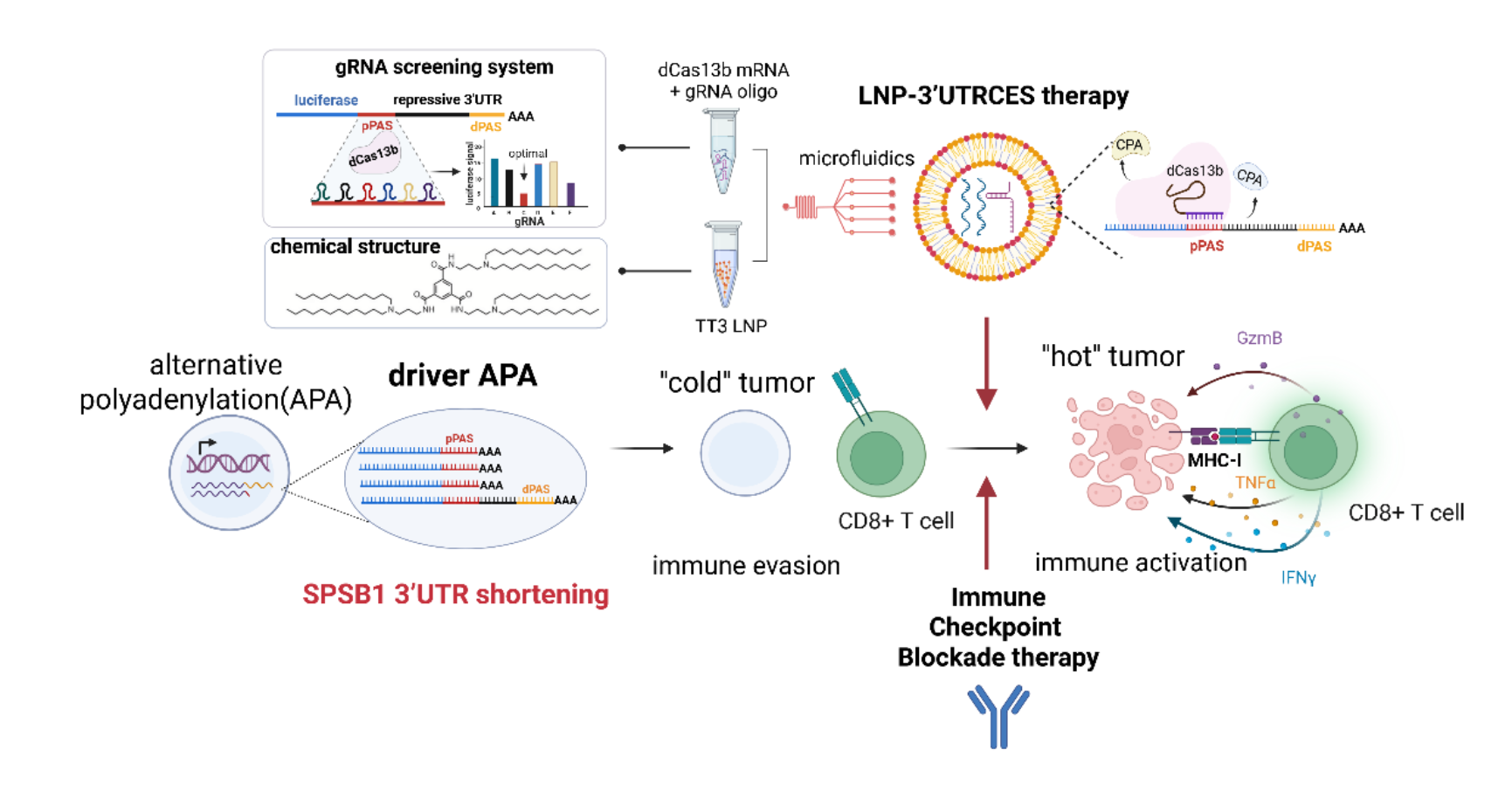
Figure. Schematic illustration of the mechanism by which programmable mRNA 3′UTR engineering restores MHC-I-mediated antigen presentation and enhances the response of prostate cancer to immunotherapy.
This study reveals a new mechanism of tumor immune evasion: tumor cells can shorten the SPSB1 mRNA 3′UTR to increase SPSB1 expression, thereby promoting MHC-I degradation, suppressing antigen presentation, and escaping immune surveillance. At the same time, the study establishes a programmable RNA engineering strategy for manipulating endogenous mRNA 3′UTRs andredirecting RNA-processing eventsreprogramming RNA regulatory processes in tumor cells without altering the genomic DNA sequence. These findings provide new insights into the role of APA in tumor immune evasion and establish a potential technological framework for developing RNA-targeted therapies and improving responses to cancer immunotherapy.
Professors Qianben Wang of the Institute of Basic Medical Sciences, Wei Li of the University of California, Irvine, and Yizhou Dong of the Icahn School of Medicine at Mount Sinai are the co-corresponding authors of the study. Former members of the Wang laboratory Furong Huang, Fuwen Yuan, and Kexin Li;, former members of the Li laboratory Ya Cui and Lei Li;, and current postdoctoral fellow Wenbin Ye are co-first authors.
Article: “Programmable mRNA 3′UTR EngineeringengineeringRestoresrestoresMHC-I and Overcomesovercomes iImmune Evasionevasionin ProstateprostateCancercancer”
Published in:Nature Biomedical Engineering
Article link:https://www.nature.com/articles/s41551-026-01720-9

