
Explore our diverse research areas, groundbreaking studies and remarkable medical research achievements
Headline:Two Papers in One Day: Shasha HanTeam at the School of Population Medicine and Public Health Publishes Health AI Research inNature MedicineandNature Health
January 19, 2026 — Uneven healthcare resources and persistent workforce shortages in primary care have made one question increasingly urgent: How can artificial intelligence (AI) be designed and deployed in real-world settings, especially in resource-limited rural areas?
On January 19, 2026, the team led by Shasha Han at the School of Population Medicine and Public Health (SPMPH) made important progress. Two studies appeared the same day in Nature Medicine and Nature Health.One introduced a codesign methodology and a large language model (LLM) chatbot built through that approach for primary care; the other focused on the transition from primary to specialist care.
The studies moved beyond technical performance metrics. They were grounded in real primary care and hospital settings across China, including rural areas with limited medical resources and constrained network access, with particular attention to older adults and people with lower socioeconomic status. The aim was to explore how AI can serve complex local healthcare systems in practice.
Using randomized controlled trials, the team systematically evaluated AI tools in real-world healthcare settings. At the methodological level, the studies show that codesign can help improve the fairness, accessibility, and practical usability of AI tools. The team also published behind-the-paper accounts in the Springer Nature community, reflecting on the research process and lessons learned.
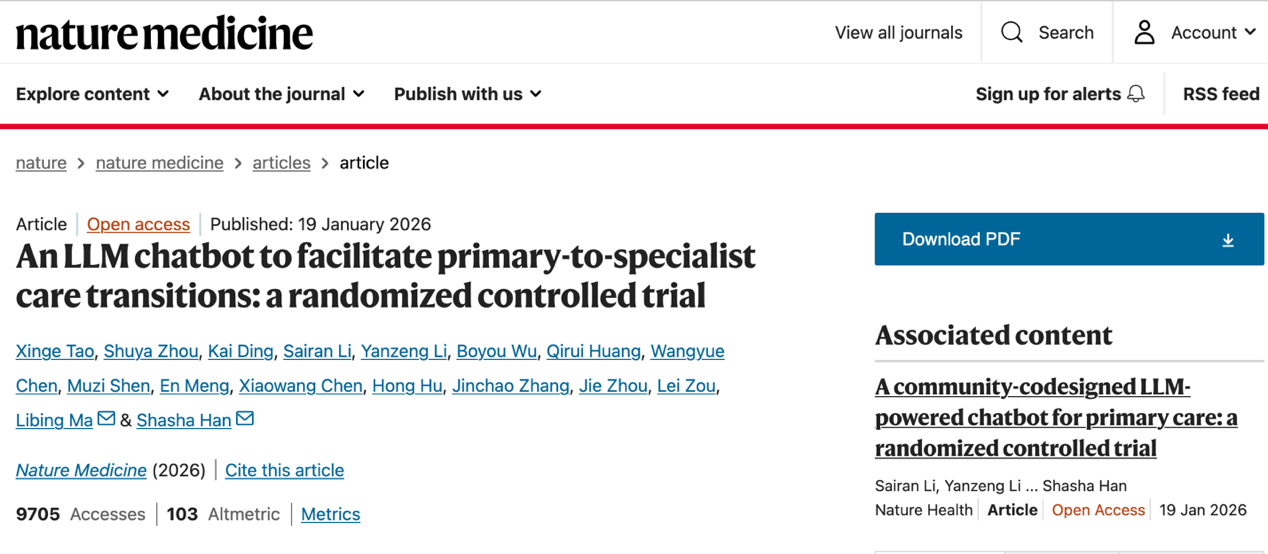
TheNature Medicinepaper, titled“An LLM chatbot to facilitate primary-to-specialist care transitions: a randomized controlled trial,”focuses on a bottleneck in hospital efficiency and service quality—the transition from primary to specialist care. Assistant Professor Shasha Han of SPMPH and Professor Libing Ma of The First Affiliated Hospital of Guilin Medical University are co-corresponding authors. Doctoral candidate Xinge Tao and master’s student Shuya Zhou of SPMPH, and doctoral candidate Kai Ding of The First Affiliated Hospital of Guilin Medical Universityare co-first authors.
Working with patients, family members, community workers, and clinicians, the team developed PreA, a pre-assessment chatbot that collects patient information before visits and generates structured reports for doctors. Its core purpose is to support information collection and clinician-patient communication in specialist care.
The randomized controlled trial ran in two tertiary hospitals in western China, covering 24 departments and enrolling 2,069 patients. The results show that PreA helped clinicians understand patients’ conditions more quickly, improved care coordination, and enhanced clinician-patient communication. Further analysis found that clinicians did not blindly adopt AI-generated reports.
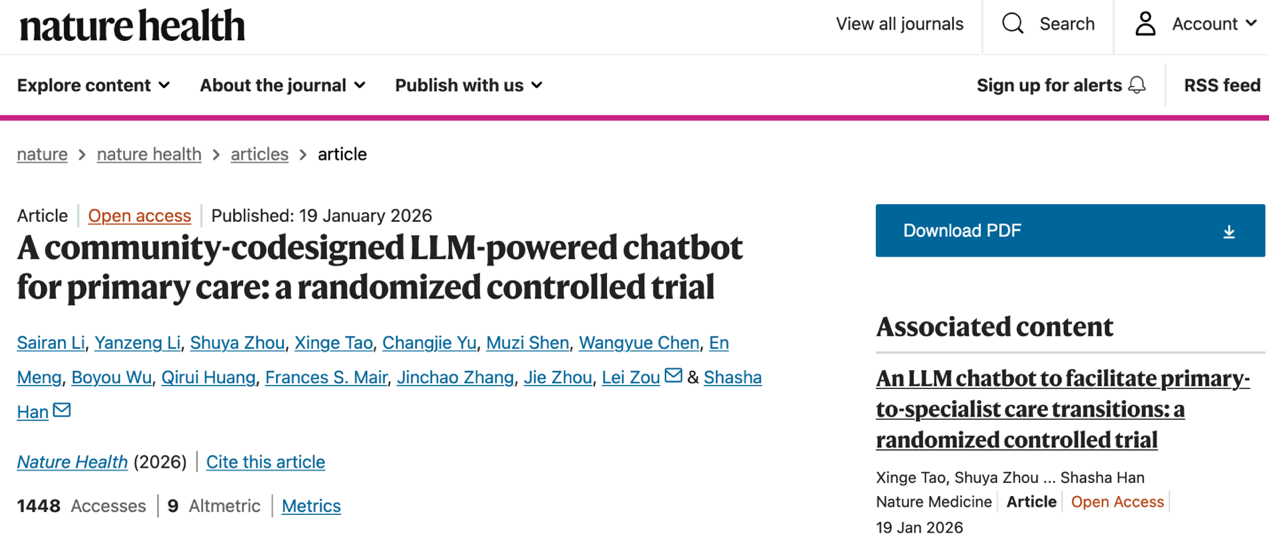
TheNature Healthpaper, titled“A community-codesigned LLM-powered chatbot for primary care: a randomized controlled trial,”addresses the relative shortage of medical resources in rural and primary care settings. Assistant Professor Shasha Hanof SPMPHand Professor Lei Zouof Peking Universityare co-corresponding authors. Master’s student Sairan Li of SPMPH and Lecturer Yanzeng Li of Beijing Normal Universityare co-first authors.
The study proposes a “dual-track role-playing” codesign method, bringing together patients, caregivers, and community workers from 11 provinces in China alongside researchers. Through role reversal and scenario simulation, participants discussed practical needs from different perspectives and jointly built P&P Care (Population Medicine & Public Health), a health consultation chatbot for primary care.
The randomized controlled trial enrolled more than 2,100 participants, 59.1% of whom were from rural areas. Participants who used P&P Care showed a steady trend toward improvement in understanding health information and expressing themselves during consultations, with more pronounced gains among middle-aged and older adults and women. The study indicates that multi-stakeholder codesign is a key pathway for strengthening the cultural adaptability of AI tools and integrating local knowledge into community health services.
Taken together, the two studies address one core question from different angles: In resource-limited settings, the real-world value of healthcare AI depends not only on technical capability but also on whether the development process is embedded in real medical contexts and shaped by multiple stakeholders. The research shows that combining technology development with local medical practice—and respecting how healthcare professionals and communities already work—can strengthen the potential of AI tools in real-world applications.
The two studies were led byShasha Hanand conducted in collaboration with Peking University, Beijing Normal University, Tencent WeChat AI, The First Affiliated Hospital of Guilin Medical University, The Affiliated Hospital of Gansu Medical College, and other institutions. The work was supported by the National Natural Science Foundation of China, the CAMS Innovation Fund for Medical Sciences, and other sources.
Paper information:
Tao, X., Zhou, S., Ding, K. et al. An LLM chatbot to facilitate primary-to-specialist care transitions: a randomized controlled trial.Nat Med(2026).https://doi.org/10.1038/s41591-025-04176-7
Li, S., Li, Y., Zhou, S. et al. A community-codesigned LLM-powered chatbot for primary care: a randomized controlled trial.Nat Health(2026).https://doi.org/10.1038/s44360-025-00021-w
Behind the paper:
Building a primary care chatbot with people, not for them.https://communities.springernature.com/posts/298529
Why building AI for healthcare requires stakeholders, not just a dataset.https://communities.springernature.com/posts/301897

