
Explore our diverse research areas, groundbreaking studies and remarkable medical research achievements
Source: Yunnan Fuwai Cardiovascular Hospital · Published: 22 April 2026
Original URL: https://www.yntv.cn/news/20260422/1776843225794758.html
In April 2026, an intercontinental cardiac interventional procedure spanning ten thousand kilometres was successfully completed. Professor Pan Xiangbin, Executive President of Yunnan Fuwai Cardiovascular Hospital, was in Bordeaux, France. Using China's original pure-ultrasound-guided interventional technology system and a domestically developed surgical robot system, he successfully performed a fully ultrasound-guided, robot-assisted transcatheter mitral edge-to-edge repair on a patient ten thousand li away.
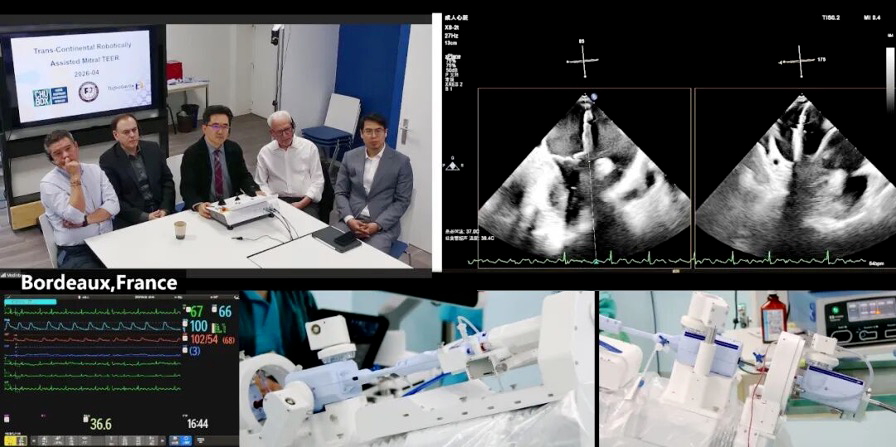
Professor Pan Xiangbin, together with leading international cardiovascular experts in France, performing ultrasound-guided interventional mitral edge-to-edge repair via an intercontinental remote robot
Years in the Making: A Technological Leap from Two Thousand Kilometres to a Transcontinental Ten Thousand Li
This transcontinental procedure did not happen overnight; it was the inevitable leap of continuously iterated original Chinese technology. Back in 2024, Professor Pan Xiangbin's team at Fuwai Hospital used a domestically produced surgical robot system to achieve the world's first remote mitral valve repair, successfully bridging 2,000 kilometres to save a patient's life. Over two years of development, the team further built a mature system of technical validation and quality-control standards. From domestic remote surgery to this intercontinental procedure, the technology pathway has undergone a qualitative change from "a centre radiating to its surroundings" to "collaboration without borders" — the operator no longer needs to be in the same country as the patient, or even on the same continent; a network connection is all that is required to perform high-precision cardiac intervention.
Pure Ultrasound Guidance (PANProcedure): Laying a "Chinese Foundation" for Remote Robotic Surgery
If remote robotics solved the problem of "distance," the imaging guidance method determines whether the robot can truly deliver value. For a long time, interventional surgical robots have had the potential for remote, precise control, yet they have run into a serious development bottleneck: the single-plane radiographic fluoroscopy relied on in European and American systems is essentially a two-dimensional projection that cannot display the three-dimensional structures inside the heart, reducing the robot's multidimensional fine manipulation to single-plane advancement — rather like forcing a 3D film into a comic strip — so that the robot's advantages cannot be realized at all. Moreover, radiation-based systems require expensive, bulky, large-scale DSA equipment. Even in developed countries, catheterization laboratories are far from universally available, and in the grassroots hospitals, disaster zones or battlefields where remote surgery is genuinely needed, there is no catheterization laboratory at all, so the remote value of the robot cannot be realized. Under a radiation-based system, therefore, the surgical robot is merely a "remote pusher" rather than true "remote surgery."
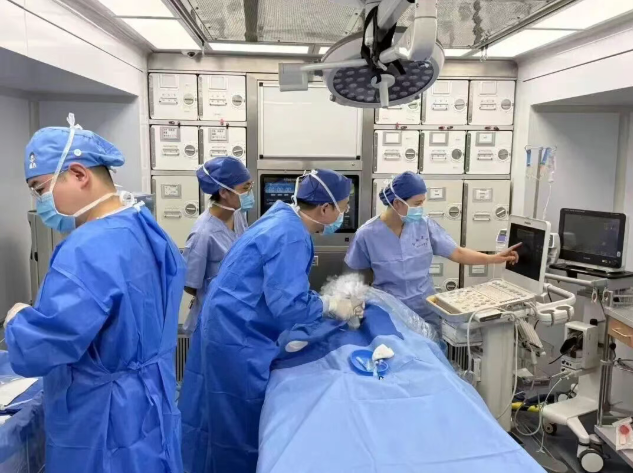
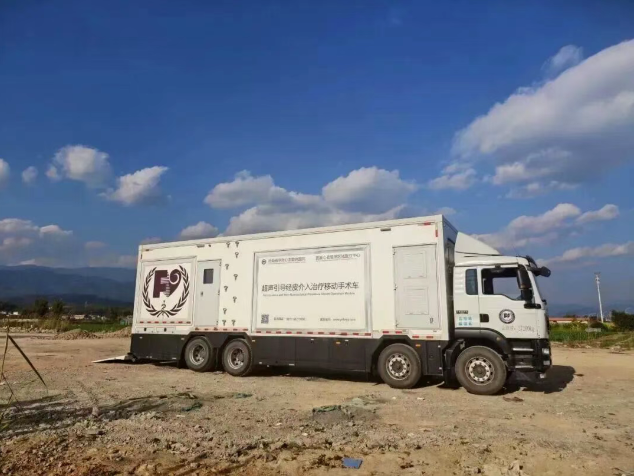


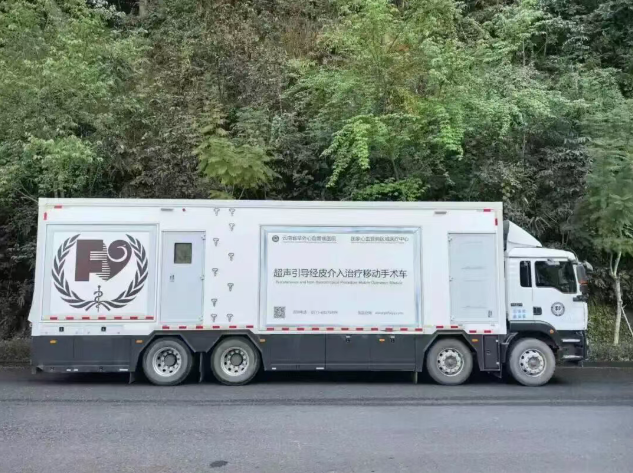
The "radiation-free percutaneous interventional technique" (PANProcedure) pioneered by Professor Pan Xiangbin has overcome these chronic problems at the level of fundamental methodology: ultrasound guidance can display the three-dimensional structures of the heart in real time throughout the procedure, giving full play to the robot's multidimensional precision orientation capability, and it frees surgery entirely from dependence on the catheterization laboratory, achieving treatment of heart disease "without opening the chest, without radiation, and even with the patient fully awake." In addition, the mobile ultrasound surgical vehicle developed by the Fuwai team requires no lead shielding or heavy radiation equipment, and integrates advanced equipment such as a space-expansion system and a reversible operating table. The innovative combination of the mobile surgical vehicle and the remote surgical robot has taken the interventional surgical robot from "having nowhere to be useful" to "having great potential." It can both meet the urgent need for skilled physicians at the grassroots level and efficiently deliver remote, doorstep procedures that "go from village to village," opening up a new model for treating cardiovascular disease.
At present, 12 such surgical vehicles are already treating patients on the move around the world. By deploying surgical robot terminals on the vehicles, specialists can remotely control the robotic arms inside them to perform minimally invasive interventions. This "treat as you travel" model shows unique advantages in extreme settings that lack catheterization laboratories, such as disaster zones and battlefields, greatly narrowing the gap in healthcare capability between different countries and regions. It has been awarded the World Health Organization's science and technology innovation award.
Patient Case: Remote Robotic Cardiac Intervention Benefits an Elderly, High-Risk Patient
The patient was a 73-year-old man with more than three months of shortness of breath on exertion. Ultrasound indicated prolapse of the lateral commissure and the A1 segment of the mitral valve, with severe mitral regurgitation (4+). The patient also had atrial fibrillation, coronary heart disease, intracranial arterial stenosis and COPD — all high-risk factors for conventional surgery. After comprehensive preoperative assessment, rigorous review and full discussion with the patient and family, the decision was made to use robot-assisted transcatheter mitral edge-to-edge repair to relieve the patient's condition in a minimally invasive, efficient and safe manner.
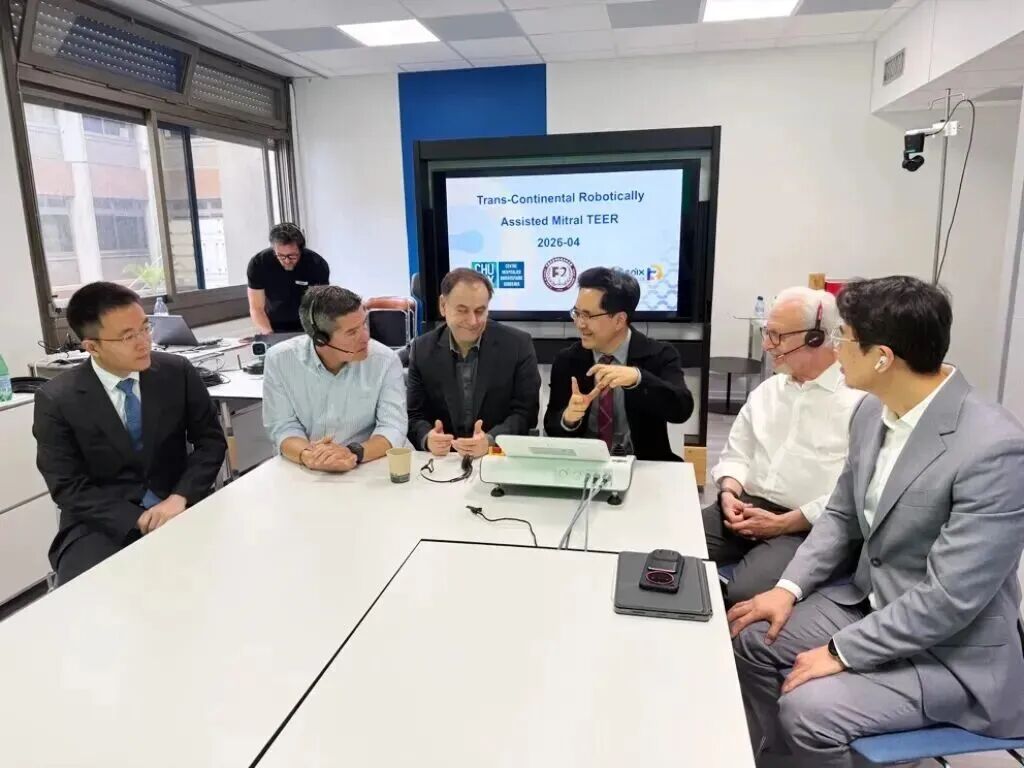
Professor Pan Xiangbin in discussion with experts from France, the United States and other countries
The procedure attracted wide attention in academic circles. Professor Martin Leon of New York University, chairman of TCT, led experts from France, the United States, Germany, Italy, Canada and other countries to observe the operation in France. From Bordeaux, Professor Pan Xiangbin used the control terminal to remotely and precisely operate the surgical robot and complete the interventional procedure. The operator was in France and the patient ten thousand li away; supported by the pure-ultrasound-guided interventional technology system, the operation was entirely freed from dependence on large imaging equipment, greatly reducing the demands that remote operation places on facilities and equipment. In the future, with the ultrasound interventional surgical vehicle, the operator will not need to be physically present at the operating site and will be able to perform high-precision cardiac intervention remotely — surgery will change from "having to enter an operating room" to "being possible wherever the mobile vehicle can reach," significantly expanding its boundaries in time and space and, with them, the accessibility of medical services.
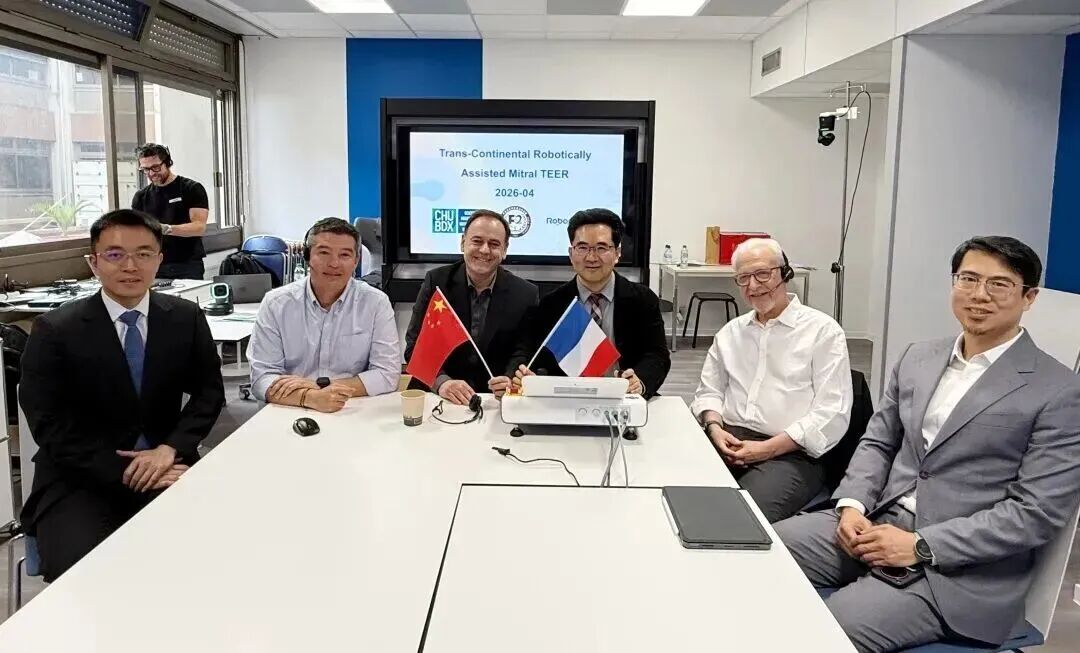
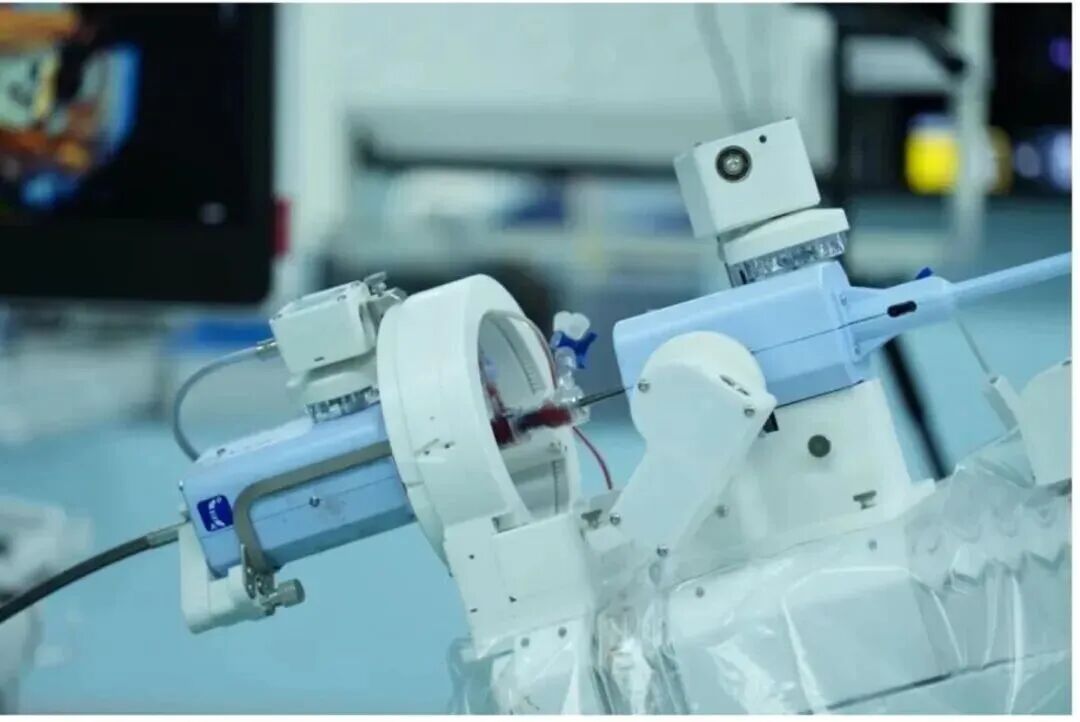
Relying on 5G plus international dedicated-line communication technology, the system kept transmission latency within 200 milliseconds, achieving low-latency, highly stable, sub-millisecond-level precise control and ensuring that the cross-border procedure ran smoothly, safely and reliably throughout. The operation was completed through a single puncture site at the groin, with no incision, no radiation and no contrast agent at any point, achieving truly "ultra-minimally invasive" interventional diagnosis and treatment. The procedure lasted about 60 minutes and proceeded smoothly and steadily; Professor Pan operated the robot and achieved successful clipping on the first attempt. Postoperatively the mitral regurgitation had essentially disappeared, and the operation was a complete success.
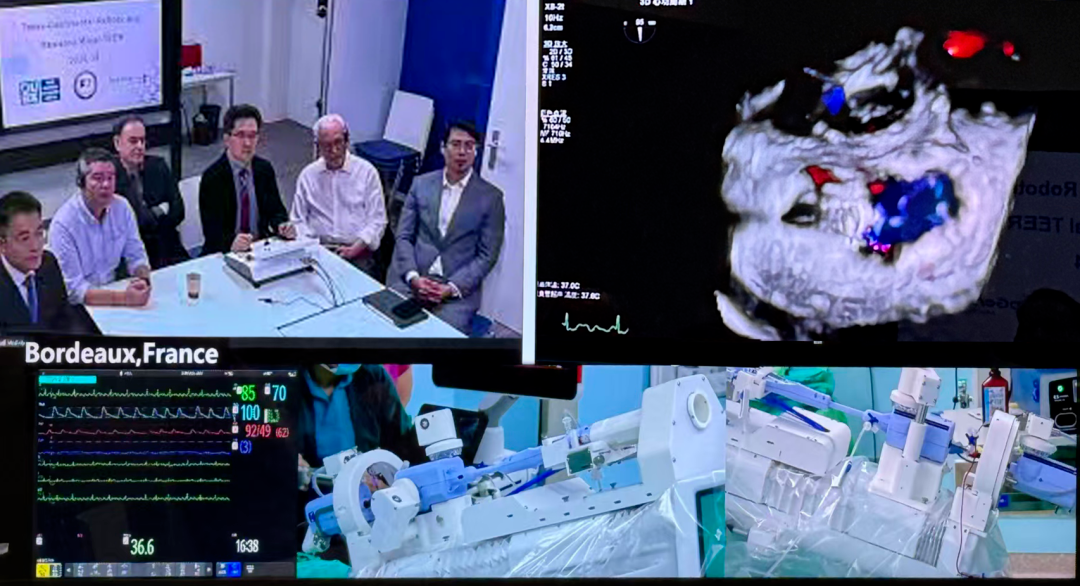
Professor Pan Xiangbin precisely controlling the robotic arm to complete the interventional procedure via remote network signals
Chinese Original Technology, Shared with the World
The success of this transcontinental procedure is another milestone in the global development of the PANProcedure technology system. Academician Hu Shengshou, director of the National Center for Cardiovascular Diseases, recognized the direction in which the discipline was heading and, more than a decade ago, set about building a hybrid technical team that combined interventional and surgical techniques, exploring and innovating continuously to develop and progressively refine the ultrasound-guided interventional technology system. To date, the PANProcedure has been adopted in more than 60 countries and over 1,000 hospitals. It saves lives in developing countries across Asia, Africa and Latin America, and has also entered the healthcare systems of developed countries such as the United Kingdom, France, Germany and Canada, training large numbers of local doctors — not only "giving a fish" but "teaching how to fish" — and completing a historic leap from "importing technology" to "exporting solutions." It has repeatedly received letters of appreciation from Chinese and foreign governments and has been written into joint government communiqués.
The PANProcedure technology system has won broad international acclaim for its considerable advantages. To accelerate its promotion and application, the United Nations, through the Peace and Development Fund, has supported the establishment of a project on "strengthening cardiac treatment capacity using PANProcedures," supporting the training of more doctors and the saving of more patients.
Under the United Nations principles of "sustainable development" and "all people are born equal," more international organizations have joined the effort to promote the PANProcedure. The international standards organization IEEE has made the "PANProcedure" international standard permanently free to access, so that doctors, medical institutions and workers in remote areas can download and use it, giving patients in impoverished areas the same right to receive a standardized PANProcedure.
Driven by Fundamental Methodological Innovation: Building an Original Chinese Technology System
The success of this pure-ultrasound-guided remote robotic interventional procedure is the natural result of the Fuwai Hospital team's deep work on fundamental methodological innovation and its promotion of the deep integration of medicine and technology. Pure ultrasound guidance is like a "highway," and the remote robot is the "smart racing car" travelling on it — a road already proven passable in Beijing, Kunming and Shenzhen, and now driven across continents. It proves once again that original, disruptive innovation can create new quality productive forces and give interventional surgical robots a place to be useful; China's original ultrasound-guided technology has taken a different path, paving a solid and feasible road for surgical robots to reach the grassroots and destinations ten thousand li away.
Ultrasound-guided interventional technology is a methodology: it can continuously generate new technologies and is a form of sustainable innovation. Seventeen of its technologies have been verified as world firsts, and it has obtained more than 60 domestic and international patents. Over 20 devices have been approved for market in China and the European Union, among which the ultrasound-guided guidewire, ultrasound catheter and fully degradable closure device are the only such products on the market worldwide, opening up a new category of medical devices and achieving the major breakthrough of "having what others do not."
More importantly, methodological innovation can bring a "dimensional reduction" attack to bear on traditional technical problems. Ultrasound-guided interventional technology is like building an entirely new expressway, and this transcontinental procedure is just one of many racing cars speeding along it. The article the Fuwai team published in Nature in March, achieving 3D printing inside a beating heart, also owed much to the real-time monitoring and guidance that ultrasound-guided interventional technology provides for the beating heart. There is every reason to believe that more medical equipment and technologies will "change lanes and overtake" on this road in the future.
China's solutions, shared globally; original innovation leading the way, reshaping the future. The success of this procedure by Professor Pan Xiangbin's team marks a new breakthrough — from domestic to international — for two major achievements of independent Chinese innovation: pure ultrasound guidance and the remote surgical robot system. This is not only a milestone in China's achievement of independent control in high-end medical equipment, but also a demonstration to the world of the maturity and leadership of China's original medical technology system — reshaping the international remote surgery paradigm through fundamental methodological innovation, promoting the global sharing of high-quality medical resources, and contributing Chinese strength to building a global community of health for all.
Source: Yunnan Fuwai Cardiovascular Hospital
Editors: Yang Xuehua, Zhang Yuli (intern)
First review: Liang Ruijuan · Second review: Zhu Wenjin · Third review: Cao Chengbo

