
Explore our diverse research areas, groundbreaking studies and remarkable medical research achievements
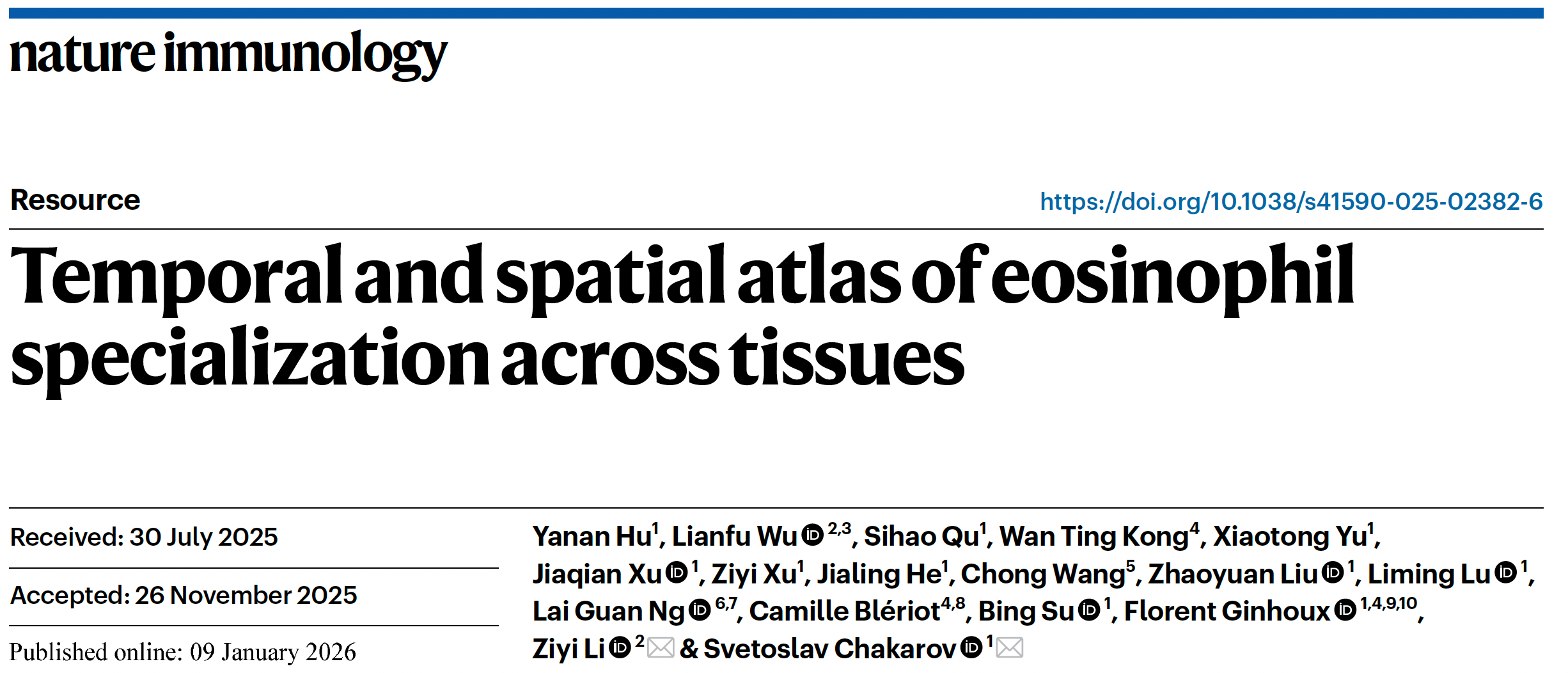
On January 9, 2026, a collaborative study led by Ziyi Li at the Institute of Systems Medicine, Chinese Academy of Medical Sciences & Peking Union Medical College / Suzhou Institute of Systems Medicine (ISM), and Dr. Svetoslav Chakarov at the Shanghai Institute of Immunology, Shanghai Jiao Tong University School of Medicine, was published in Nature Immunology. The study, entitled “Temporal and spatial atlas of eosinophil specialization across tissues,” presents the first dynamic cross-tissue atlas of eosinophil development and specialization in mice.
Eosinophils are an important population of granulocytes involved in immune regulation, metabolic homeostasis, and tissue repair. However, a fundamental question has remained unresolved: how do eosinophils acquire distinct identities and functions after entering different tissues?By integrating single-cell transcriptomics, high-dimensional surface proteomic profiling, and lineage-tracing approaches, the researchers reconstructed the eosinophil life cycle across tissues, from development in the bone marrow and circulation in the blood to tissue seeding, adaptation, and functional specialization.
The team generated the first integrated single-cell transcriptomic and surface proteomic atlas of eosinophils across the bone marrow, blood, lung, small intestine, colon, skin, and adipose tissue. The analysis revealed that eosinophils acquire distinct molecular and surface protein signatures in different tissues, enabling the researchers to establish strategies for the prospective isolation of tissue-specific eosinophil populations.The study also provides a much-needed experimental toolkit for dissecting eosinophil developmental trajectories. The researchers identified a panel of surface markers, including CD371, CD11a, CD22, and CD16.2, that can distinguish eosinophilsfrom progenitors and circulating cells to specialized tissue-resident populations. These findings overcome a longstanding technical barrier in the field and opening the door to high-resolution studies of eosinophil development and heterogeneity.
A key finding of the study is that tissue residence time is a major driver of eosinophil diversification.Lung eosinophils are the shortest-lived, are predominantly located within the vasculature, and exhibit relatively homogeneous transcriptional profiles. Colonic eosinophils have an intermediate lifespan and show limited transcriptional heterogeneity, whereas small-intestinal eosinophils are the longest-lived, are predominantly located within the tissue parenchyma, and diversify into multiple transcriptionally distinct subpopulations. Further analyses along the intestinal axis provided an especially clear illustration of this principle. The transition from the villus-rich small intestine to the colon, where villi are absent, coincided with shorter eosinophil lifespans and reduced cellular heterogeneity. Within the small intestine itself, long-lived eosinophils preferentially localized to the villi, whereas shorter-lived populations were largely confined to crypt regions.Together, these findings reveal that eosinophil fate is shaped not simply by the tissue in which a cell resides, but also by where within that tissue it is located and how long it remains there. The interplay between microanatomical localization and tissue residence time therefore emerges as a core mechanism governing eosinophil maturation, heterogeneity, and functional specialization.
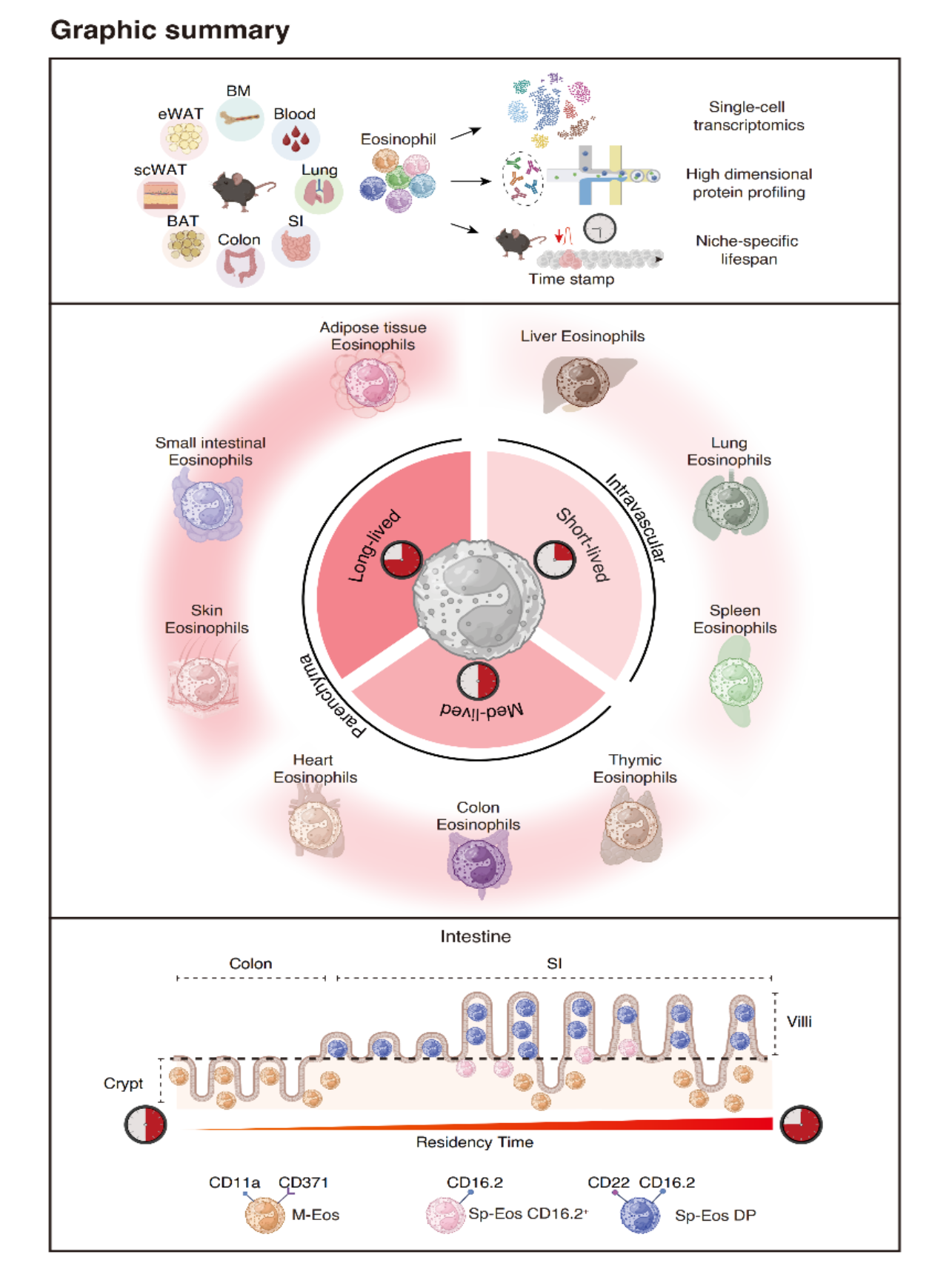
Overall, this study establishes tissue residence time as a major determinant of eosinophil functional specialization. Short-lived eosinophils maintain relatively uniform molecular states, whereas prolonged exposure to local tissue environments enables the progressive emergence of hierarchical molecular and phenotypic diversity. Beyond providing a comprehensive framework for understanding eosinophil development, the atlas offers an important resource for investigating eosinophil functions in mucosal barrier immunity, systemic metabolism, inflammation, and tissue repair.
Full article: https://rdcu.be/eYjeb

