
Explore our diverse research areas, groundbreaking studies and remarkable medical research achievements
A collaborative team led by Tao Cheng, Hui Cheng, and Toshio Suda from the Institute of Hematology & Blood Diseases Hospital, Chinese Academy of Medical Sciences & Peking Union Medical College, together with Prof. Qi Chen from the Guangzhou Institutes of Biomedicine and Health, Chinese Academy of Sciences, published a research article online in Blood entitled, Procr⁺ endothelial progenitor cells govern hematopoiesis through fine-tuning mesenchymal stem cell niche signals.
Hematopoietic stem cells (HSCs) rely on the bone marrow microenvironment to maintain their quiescence, self-renewal, and differentiation capacity. Endothelial cells, mesenchymal stem cells (MSCs), and other stromal cells collectively constitute the hematopoietic microenvironment in the bone marrow and establish a complex signaling network that regulates hematopoiesis. With the development of genetic and imaging technologies, our understanding of the structure and function of the hematopoietic microenvironment has been progressively refined and updated. Endothelial cells are an indispensable component of the bone marrow microenvironment and participate directly or indirectly in the regulation of HSC function. However, how endothelial cells integrate multiple microenvironmental signals to precisely regulate hematopoiesis remains incompletely understood.
Using lineage tracing, single-cell RNA sequencing, and multiple complementary approaches, the research team systematically characterized the distribution and functional properties of Procr⁺ endothelial cells in the bone marrow. The study found that these cells exhibit characteristics of endothelial progenitor cells and are preferentially enriched in the endosteal and metaphyseal regions. Following radiation-induced injury, Procr⁺ endothelial cells rapidly expanded, suggesting that they play an important role in vascular repair. Further functional studies demonstrated that endothelial-specific deletion of Procr severely disrupted the structure and function of the bone marrow vasculature. At the same time, Procr deficiency reduced the MSC population and altered MSC differentiation toward adipogenic and osteogenic lineages, ultimately leading to disruption of the bone marrow microenvironment and impaired hematopoietic function.They further identified a conserved population of PROCR⁺ endothelial progenitor cells in human bone marrow and demonstrated that these cells exhibit regulatory functions similar to those observed in mice, including enhancement of Notch signaling in MSCs and maintenance of hematopoietic stem and progenitor cell function.
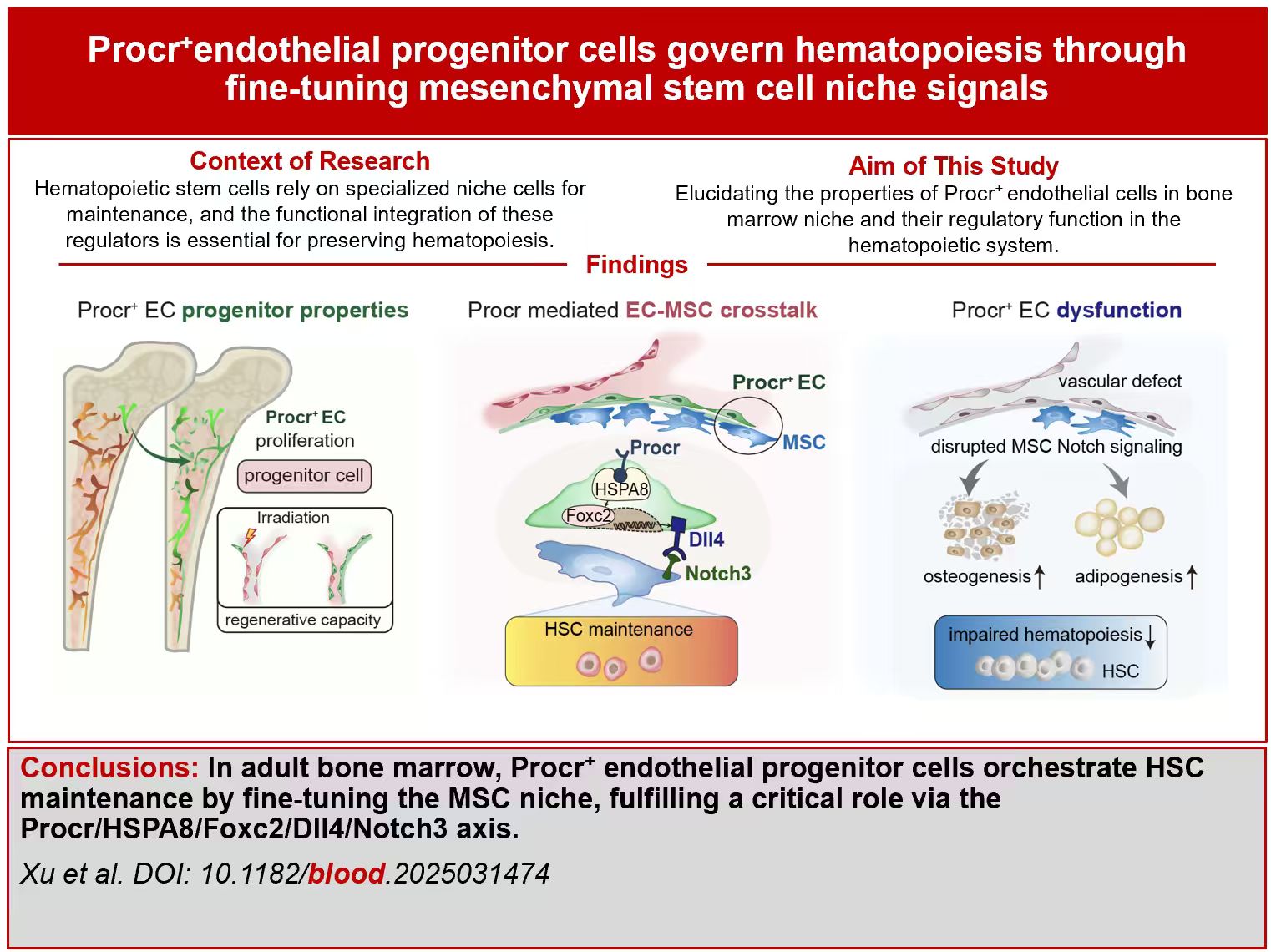
Overall, this study identifies a functionally important population of Procr⁺ endothelial progenitor cells in the bone marrow and reveals the molecular mechanism by which these cells maintain HSC function through regulation of MSC fate and niche signals. The findings provide a new perspective on the fine regulation of the hematopoietic microenvironment and suggest potential therapeutic targets for radiation-induced injury, age-related hematopoietic dysfunction, and bone marrow regeneration.
This study was supported by the Ministry of Science and Technology of China (2021YFA1100900 and 2025YFA1804701), the National Natural Science Foundation of China (82525002, 92468206 and 82400144), the Chinese Academy of Medical Sciences (CAMS) Initiative for Innovative Medicine (2025-I2M-GCC-005, 2021-I2M-1-019, 2024-I2M-ZD-010, 2021-I2M-1-040 and 2023-I2M-2-007), Haihe Laboratory of Cell Ecosystem Innovation Fund (24HHXBSS00006) and Tianjin Municipal Science and Technology Commission Grant (25ZXZSSS00410). Hui Cheng, Tao Cheng, Qi Chen and Toshio Suda served as co-corresponding authors. Chang Xu, Xue Lvand Shangda Yang contributed equally as co-first authors.
Link:https://doi.org/10.1182/blood.2025031474

