
Explore our diverse research areas, groundbreaking studies and remarkable medical research achievements
On March 5, 2026, Associate Research Fellow Wang Ye of the School of Population Medicine and Public Health (SPMPH) at Peking Union Medical College, together with Professor Jennifer K. Quint's team at Imperial College London, published a research paper online in the European Respiratory Journal (ERJ) titled “Developing and Validating the CE-MACE Model to Predict One-Year Major Adverse Cardiovascular Events Post COPD Exacerbation Using Routine Healthcare Data.” Using routine healthcare data, the study developed and validated the CE-MACE prediction model, which accurately identifies the risk of major adverse cardiovascular events (MACE) within one year following an acute exacerbation of chronic obstructive pulmonary disease (COPD), providing a scientific tool to support multidisciplinary, integrated care for COPD patients.
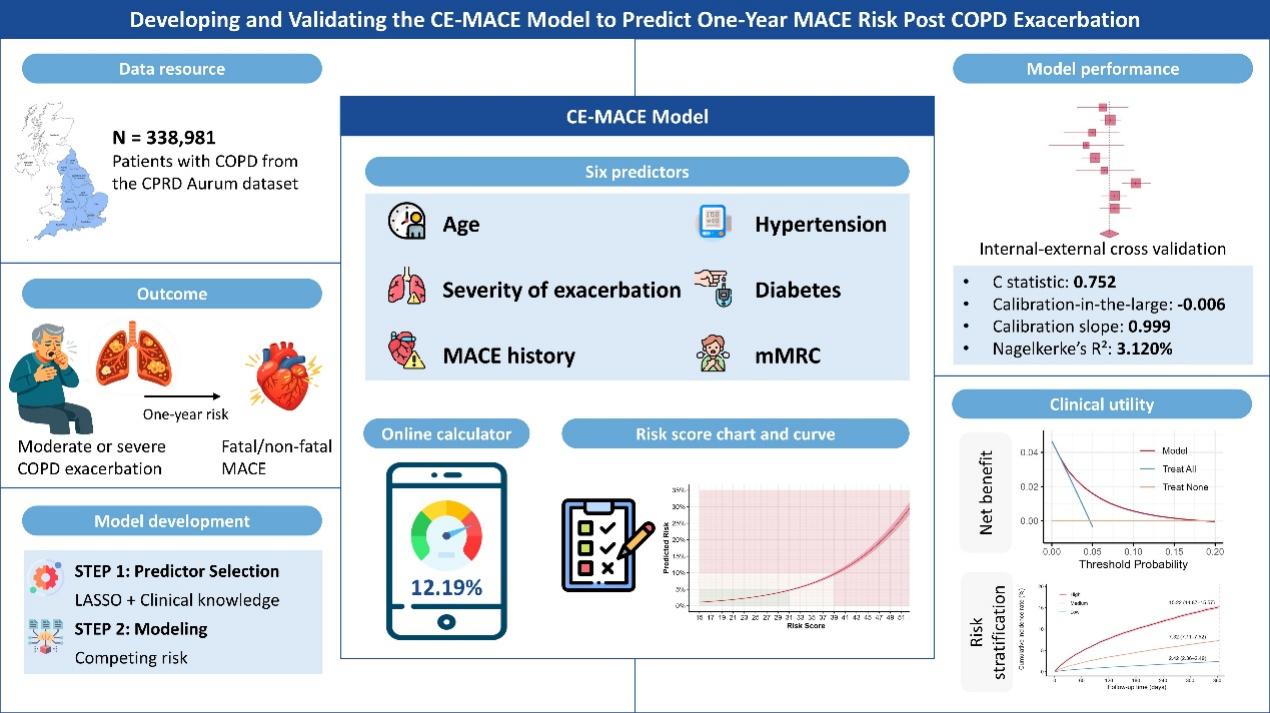
Framework for the development and validation of the CE-MACE model
Patients with chronic obstructive pulmonary disease (COPD) face a higher risk of cardiovascular events than the general population, and this risk rises markedly after an acute exacerbation of COPD. Previous studies have shown that classic cardiovascular risk prediction models such as QRISK3 underestimate risk in this population, highlighting the urgent need to develop and validate new prediction models capable of accurately forecasting cardiovascular event risk in COPD patients.
Using the UK's Clinical Practice Research Datalink (CPRD), the research team included 338,981 patients aged 40 and older who had experienced a moderate or severe acute exacerbation of COPD. The study outcome was fatal or non-fatal major adverse cardiovascular events (MACE) — including acute coronary syndrome, arrhythmia, heart failure, and stroke — occurring within one year after the exacerbation. Drawing on clinical expert opinion and prior evidence, the study initially considered 21 candidate predictors, from which important variables were selected using LASSO regression. Combining the LASSO regression results with clinical relevance, the researchers ultimately included six predictors that are common and readily available in clinical practice: age, severity of the acute exacerbation, history of prior MACE, mMRC dyspnea grade, history of hypertension, and history of diabetes. A competing-risks model was used to estimate the regression coefficients of the predictors, and the team developed a web-based prediction tool; using the regression coefficients, they also developed an easy-to-use clinical risk-scoring scale.
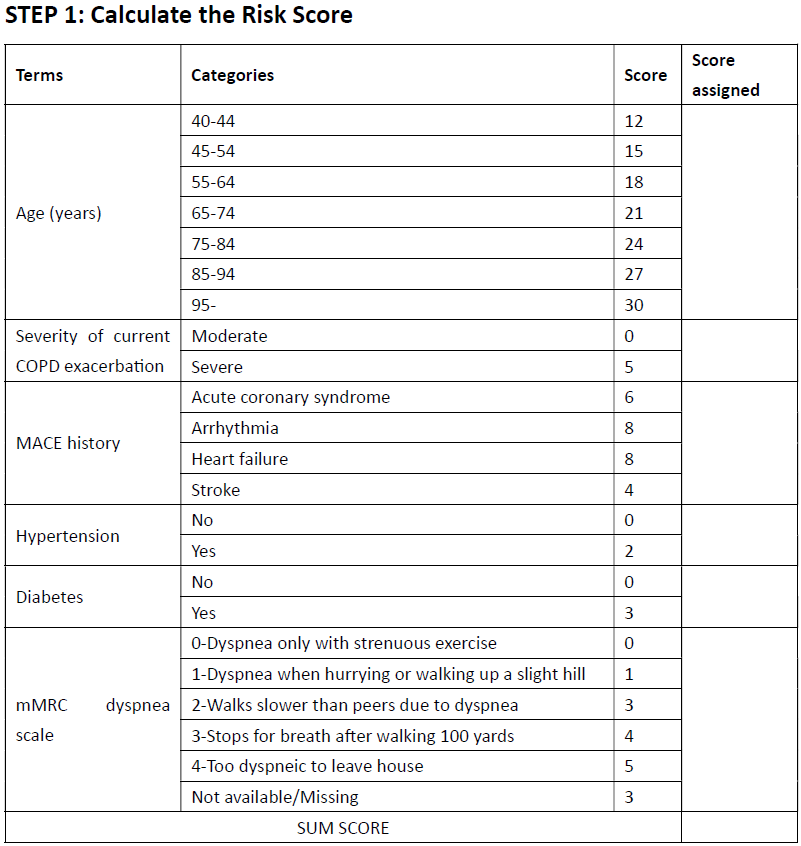
Simplified scoring scale for the CE-MACE model
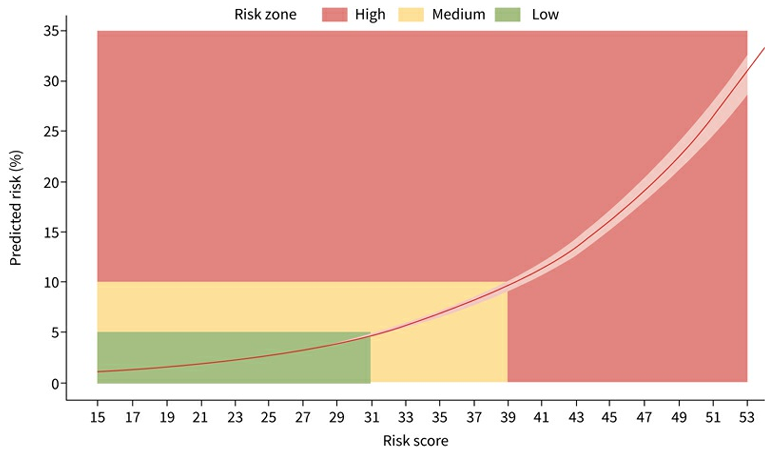
Predicted probabilities corresponding to the CE-MACE scoring scale
The predictive performance of the CE-MACE model was comprehensively evaluated using an internal-external cross-validation strategy. The results showed a discrimination (C-statistic) of 0.752, an overall calibration of −0.006, and a calibration slope of 0.999, indicating that the model effectively distinguishes between high- and low-risk patients and that predicted probabilities align well with observed probabilities. Sensitivity analyses showed that CE-MACE performed well regardless of whether patients had a prior history of COPD exacerbations.
Based on large-scale, real-world healthcare data, this study constructed a prediction model for accurately assessing cardiovascular risk in COPD patients, filling a research gap in this field internationally. The risk-assessment tool developed in the study can support wider adoption in clinical practice, and the findings are expected to promote integrated care for COPD and precise prevention of cardiovascular events.
This research was supported by the National Key Research and Development Program of China (2023ZD0506402) and the CAMS Innovation Fund for Medical Sciences (2021-I2M-1-049), among other grants. Associate Research Fellow Wang Ye is the sole first author and sole corresponding author of the paper, and Professor Jennifer K. Quint of the School of Public Health at Imperial College London is the last author. From January 6, 2025 to January 5, 2026, Dr. Wang Ye received support from the China Scholarship Counciland carried out postdoctoral research at Imperial College London. This study is one of the major international collaborative achievements of that visit, and it has played an active role in advancing the School's international academic exchange and cooperation.
Paper link:
https://publications.ersnet.org/content/erj/early/2026/02/26/1399300302555-2025
Web-based prediction tool:
https://ce-mace.shinyapps.io/shiny/

