
Explore our diverse research areas, groundbreaking studies and remarkable medical research achievements
A new clinical study by Prof. Jun Shi and Haiqing Xiongfrom PUMC & CAMSpublished in the New England Journal of Medicinereports that CD19-targeted chimeric antigen receptor (CAR) T-cell therapy can induce rapid and durable drug-free remission in patients with multi-refractory autoimmune hemolytic anemia (AIHA), a severe autoimmune blood disorder for which effective treatment options are limited.
AIHA is a rare but potentially life-threatening autoimmune disorder in which the immune system destroys red blood cells, causing severe anemia and repeated disease relapses. Although corticosteroids and rituximab are standard first- and second-line therapies, many patients eventually become refractory to treatment or experience multiple relapses, leaving few effective therapeutic options.
The investigator-initiated study enrolled 11 patients with primary AIHA who had failed at least three previous lines of therapy, including anti-CD20 treatment. Following a single infusion of autologous CD19 CAR-T cells, all patients achieved an objective response within three months. Clinical responses occurred rapidly, with a median time to partial remission of 16.5 days and complete remission of 45 days. Most patients were able to discontinue immunosuppressive therapy and maintained sustained drug-free remission during follow-up.The therapy also demonstrated a favorable safety profile. Cytokine release syndrome was predominantly mild (grade 1), with no severe neurotoxicity or treatment-related deaths observed.
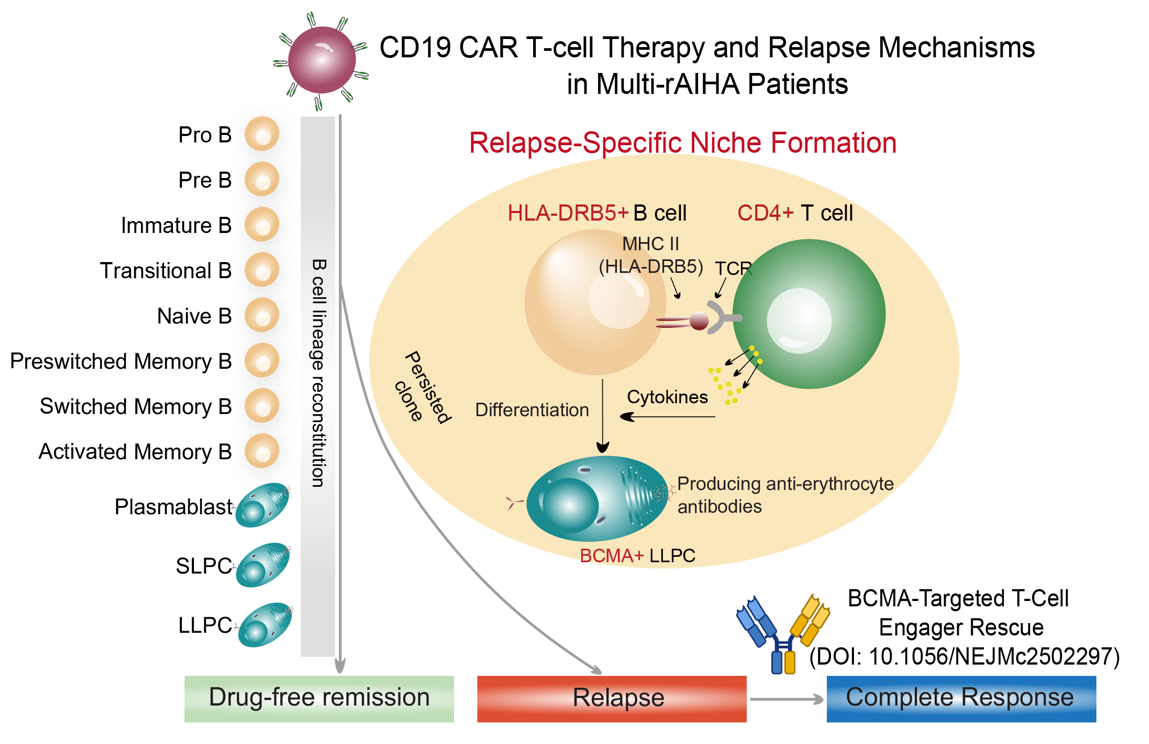
Beyond the encouraging clinical outcomes, the study provides important mechanistic insights into disease relapse. Using longitudinal single-cell transcriptomic and immune repertoire analyses of bone marrow and peripheral blood, the investigators tracked immune reconstitution after CAR-T therapy. They found that durable remission was characterized by reconstitution of predominantly naïve B cells, whereas relapse was associated with the emergence of HLA-DRB5–expressing B cells, increased CD4⁺ T-cell activation, and persistence of BCMA-positive long-lived plasma cells. These findings suggest that relapse is driven by a distinct immune microenvironment rather than simple B-cell recovery alone.
The study establishes CD19 CAR-T therapy as a promising treatment strategy for patients with highly refractory AIHA while providing a biological framework for understanding treatment resistance and disease recurrence. The identification of relapse-associated immune pathways may also inform the development of next-generation combination therapies and personalized monitoring strategies for autoimmune diseases.
Taken together, these findings expand the therapeutic potential of CAR-T cell therapy beyond hematologic malignancies and highlight its emerging role in the treatment of severe autoimmune disorders.Larger studies with longer follow-up will be needed to confirm durability, long-term safety, and the patients most likely to benefit.
This study was supported by the National Key Research and Development Program of China (2024YFC2510500), the National Natural Science Foundation of China (82270145, 82300162, 82100145, and 32470884), and the Chinese Academy of Medical Sciences Innovation Fund for Medical Sciences (2023-I2M-2-007, 2021-I2M-2-073, 2021-I2M-2-003, 1401-2024-3-19, and 2022-I2M-1-022), among other funding sources. Jun Shi and Haiqing Xiong served as co-corresponding authors. Ruonan Li, Hong Pan, Lele Zhang, and Jiaxiu Ma contributed equally as co-first authors.

