
Explore our diverse research areas, groundbreaking studies and remarkable medical research achievements
The multifaceted dysfunction of tumor-infiltrating T cells, especiallyexhaustion and mitochondrial dysfunction, remains a major obstacle in cancer immunotherapy. Transcriptomic and epigenomic regulations of T cell dysfunction have been extensively studied, but the role of proteostasis in regulating these obstacles remains less defined. On January 14, 2026, a collaborative team led by Guideng Li(Suzhou Institute of Systems Medicine, Chinese Academy of Medical Sciences) and Philip D. Greenberg(Fred Hutchinson Cancer Center) published a research article entitled “The Ubiquitin Ligase KLHL6 Drives Resistance to CD8⁺ T Cell Dysfunction” in Nature. The study revealed the mechanistic link between sustained TCR signaling and T cell exhaustion, offering novel insights into the roles of dysregulated protein signaling and impaired proteostasis in driving T cell dysfunction.
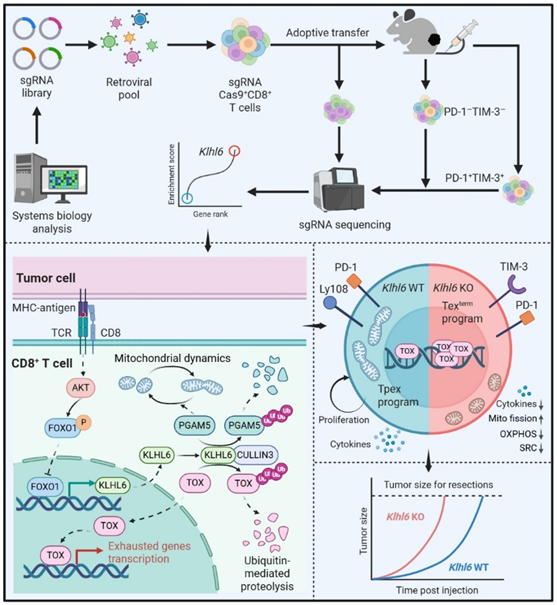
By integrating computational analyses of T cell exhaustion and mitochondrial fitness atlases with in vivo CRISPR screens, weidentified the E3 ubiquitin ligase KLHL6 as a dual-negative regulator of both T cell exhaustion and mitochondrial dysfunction.Mechanistically, KLHL6 promoted TOX poly-ubiquitination and subsequent proteasomal degradation, thereby attenuating the transition of progenitor exhausted T cells towards terminal exhaustion. Simultaneously, KLHL6 maintained mitochondrial fitness by constraining the excessive mitochondrial fission that occurs during chronic TCR stimulation by means of post-translational regulation of the PGAM5-Drp1 axis. However, KLHL6 expression was tightly regulated by TCR signaling, and persistent TCR stimulation resulted in sustained downregulation of KLHL6, thereby attenuating its potentially beneficial ubiquitin ligase activity under conditions of chronic antigen stimulation. Enforcing KLHL6 expression in T cells markedly improved efficacy and long-term persistence against tumors and viral infections in vivo. These findings establishKLHL6 as a multifunctional and clinically actionable target for cancer immunotherapy, underscoring the therapeutic potential of modulating proteostasis and ubiquitin-dependent regulation to improve immunotherapy.
Titles: The Ubiquitin Ligase KLHL6 Drives Resistance to CD8+ T Cell Dysfunction
Article type: Research articles
Published in: Nature
Full-text links: https://doi.org/10.1038/s41586-025-09926-8

