
Explore our diverse research areas, groundbreaking studies and remarkable medical research achievements
On March 13, 2026, Bo Huang's team at the Institute of Basic Medical Sciences, Chinese Academy of Medical Sciences, published a research article entitled "IDO1 regulating ROS rhythm reveals glycogenolysis/PPP as a cancer treatment target" in Nature Chemical Biology. The study identifies the canonical immune-checkpoint molecule indoleamine 2,3-dioxygenase 1 (IDO1) as a key regulator of reactive oxygen species (ROS) rhythmicity in tumor cells. It further elucidates a compensatory mechanism established by human tumor cells in response to hypoxia-induced disruption of ROS rhythms and proposes that dual inhibition of IDO1 and the aryl hydrocarbon receptor (AhR) can effectively overcome therapeutic resistance, providing a new translational strategy for cancer treatment.
Energy conversion is fundamental to cellular life, yet the generation of ATP inevitably produces harmful reactive oxygen species (ROS). ATP production is one side of the coin; controlling ROS so that it shifts from a lethal burden to a life-supporting signal is the other. Previous studies had shown that intracellular ROS in tumor cells exists as rhythmic waves (periodic oscillations), but the mechanism underlying this fundamental phenomenon remained unknown. Using the HyPerRed fluorescent probe, Huang's team tracked ROS dynamics and found that ROS levels in MCF-7 and several other human tumor cell lines oscillate with a period of approximately 24 hours. Remarkably, the central molecule governing this rhythm is the enzyme IDO1. The team found that IDO1, traditionally considered a cytosolic protein, actually shuttles between the nucleus and cytosol. Under low-ROS conditions, nuclear IDO1 binds Kelch-like ECH-associated protein 1 (KEAP1) and is degraded through the ubiquitin-proteasome pathway. When ROS levels rise, IDO1 interacts with exportin 1 (XPO1) through its nuclear export signal (NES), is transported to the cytosol, and binds heme released from mitochondria, thereby forming a catalytically active holoenzyme.
The IDO1 holoenzyme catalyzes the conversion of tryptophan to Kyn, which acts as an AhR ligand and exerts immunosuppressive effects by binding AhR. Huang's team further found that Kyn directly binds glucose-6-phosphate dehydrogenase (G6PD), the rate-limiting enzyme of the pentose phosphate pathway. Specifically, binding of Kyn to the S278 site of G6PD lowers the Michaelis constant (Km) for the substrate G6P and increases the maximum reaction velocity (Vmax), markedly enhancing G6PD activity. This allosteric effect rapidly activates the PPP, efficiently generating nicotinamide adenine dinucleotide phosphate (NADPH). As a key ROS-scavenging molecule, NADPH promptly lowers intracellular ROS levels. Together, these events form a closed-loop "IDO1-Kyn-G6PD-NADPH-ROS" regulatory circuit that maintains rhythmic ROS oscillations in tumor cells.
Although ROS in tumor cells normally oscillates rhythmically, this rhythmicity can be lost under conditions such as hypoxia, resulting in excessive intracellular ROS accumulation and cell death. However, a subset of tumor cells exploit high-ROS-induced sulfenylation of AhR, enabling AhR to bind the glycogen complex and promote glycogenolysis and the downstream pentose phosphate pathway. The latter generates NADPH, rapidly scavenges ROS, and maintains ROS at a moderately elevated level that instead supports tumor growth. This finding provides a comprehensive explanation for the clinical dilemma of IDO1 blockade: although IDO1 inhibition enhances antitumor immune responses, it also disrupts ROS rhythmicity and activates an AhR-mediated compensatory pathway that promotes tumor growth, ultimately offsetting its antitumor benefit. The team therefore proposed a dual-inhibition strategy targeting both IDO1 and AhR. By simultaneously targeting tumor immunity and tumor-cell ROS homeostasis while blocking a key escape route, this dual-targeting approach offers a new concept for cancer therapy.
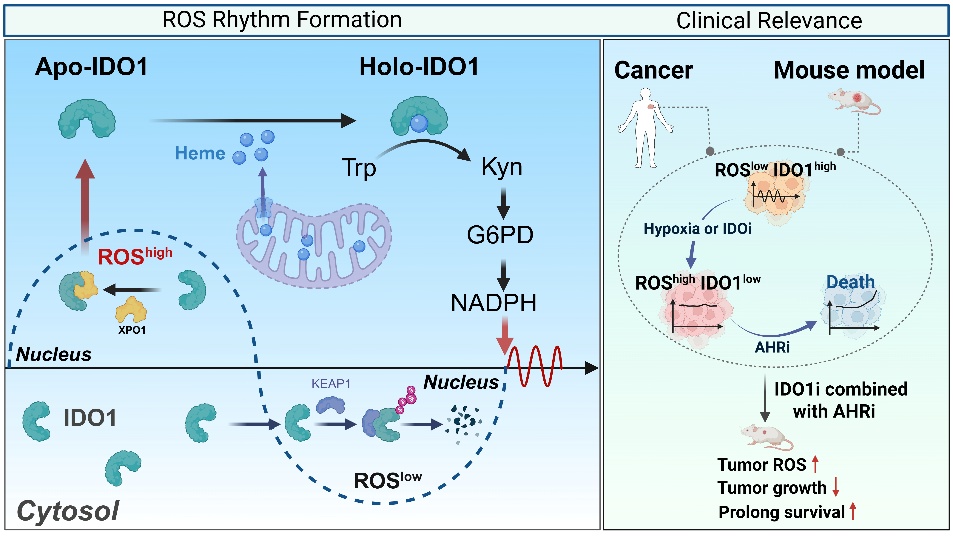
Figure 1. Schematic illustration of IDO1 maintaining ROS rhythmicity through nucleocytoplasmic shuttling and regulation of the glycogenolysis-pentose phosphate pathway
This study was supported by the Chinese Academy of Medical Sciences Innovation Fund for Medical Sciences (2021-I2M-1-021; 2023-I2M-2-005), the National Natural Science Foundation of China (82388201; 82350111), the National Key Research and Development Program of China (2022YFA1206000), and other funding programs. Professor Bo Huang of the Institute of Basic Medical Sciences is the corresponding author. Assistant Research Fellow Nannan Zhou, doctoral students Zheng Ling and Xiankai Cao, and Attending Physician Chaoqi Zhang of the Cancer Hospital, Chinese Academy of Medical Sciences are co-first authors.
Article link: https://www.nature.com/articles/s41589-026-02161-w

