
Explore our diverse research areas, groundbreaking studies and remarkable medical research achievements
Professor Jianxiang Wang and Assistant ProfessorYingxi Xu from the Institute of Hematology & Blood Diseases Hospital, Chinese Academy of Medical Sciences, together with Professor Ping-Chih Ho from the Ludwig Institute for Cancer Research, University of Lausanne, Switzerland, have published a study entitled “Proteasome-guided haem signaling axis contributes to T cell exhaustion” online in Nature.
Terminally exhausted T cells are a major challenge limiting the long-term effectiveness of T cell immunotherapies. These cells exhibit reduced effector functions, impaired proliferation, and persistent expression of inhibitory receptors. Although mitochondrial dysfunction has been linked to T cell exhaustion, the underlying mechanisms remain unclear.
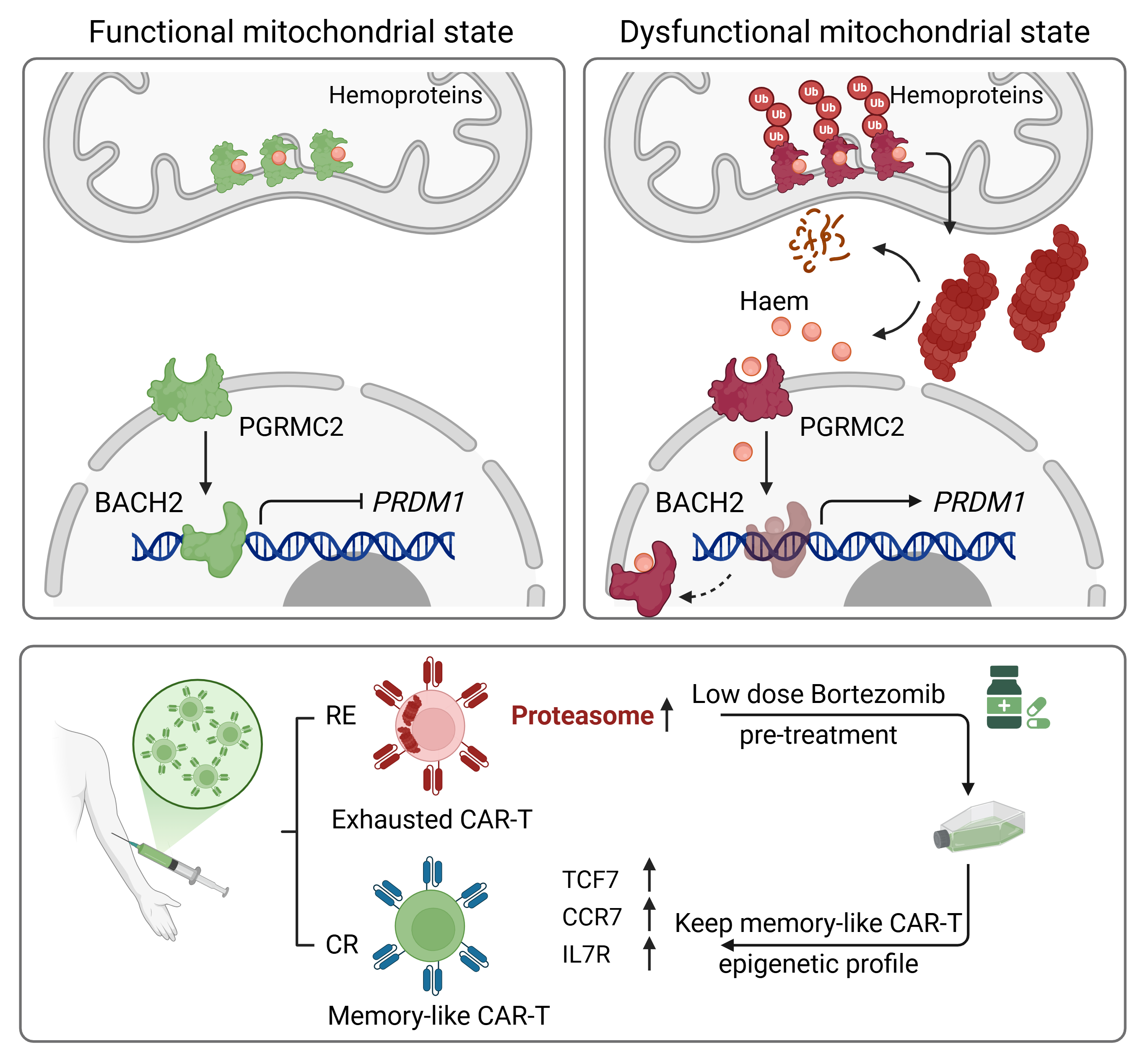
The research team found that T cells containing depolarized mitochondria showed increased proteasome activity. Proteomic analyses revealed enhanced degradation of ubiquitinated mitochondrial proteins, including haem-containing proteins, leading to elevated levels of regulatory haem (RH). Increased RH promoted the expression of exhaustion markers PD-1 and TIM-3 and reduced the production of effector cytokines such as TNF and IFN-γ.
Further studies using RNA-seq and ATAC-seq showed that RH disrupted the balance between the stemness-associated transcription factor BACH2 and the exhaustion-associated transcription factor BLIMP1, driving T cells toward terminal exhaustion. Blocking haem signaling or disrupting haem binding to BACH2 prevented terminal exhaustion and improved T cell anti-tumor activity.
To explore the clinical relevance of these findings, the team analyzed samples from patients treated with CD19 CAR-T therapy. Higher proteasome activity in CAR-T cells was associated with poorer treatment outcomes in patients with acute lymphoblastic leukemia. Importantly, transient treatment of CAR-T cells with a low dose of the proteasome inhibitor bortezomib during manufacturing reduced T cell exhaustion and enhanced anti-tumor activity.
Overall, this study identifies a new mechanism linking mitochondrial dysfunction to T cell exhaustion. The findings reveal that mitochondrial depolarization activates a proteasome–haem signaling pathway that reshapes T cell fate and provide a potential strategy for improving CAR-T cell therapy.
This work was supported by the National Key Research and Development Program of China (2021YFA1100700), the National Natural Science Foundation of China (82570279 and 82070170), and the Chinese Academy of Medical Sciences Innovation Fund for Medical Sciences (2025-I2M-XHXX-139), among other funding sources. Professor Ping-ChihHo,ProfessorJianxiang Wang and Assistant ProfessorYingxi Xuare co-corresponding authors. Assistant ProfessorYingxi Xu is the first author.

