
Explore our diverse research areas, groundbreaking studies and remarkable medical research achievements
Classical BCR::ABL1-negative myeloproliferative neoplasms (MPNs) are a group of hematologic malignancies characterized by the clonal expansion of hematopoietic stem and progenitor cells. These diseases are driven predominantly by JAK2V617F and mutations in CALR or MPL [1]. In addition to elevated blood cell counts and an increased risk of thrombosis, patients with MPNs commonly exhibit chronic inflammation and immune dysregulation. Immune abnormalities are particularly pronounced in patients harboring the JAK2V617F mutation [2,3]; however, the underlying immunoregulatory mechanisms have yet to be systematically elucidated.
On January 6, 2026, a collaborative research team led by Dr. Lei Zhang and Dr. Rongfeng Fu from the Institute of Hematology & Blood Diseases Hospital, Chinese Academy of Medical Sciences & Peking Union Medical College, published a research article online in Drug Resistance Updates (IF: 21.7). The article was entitled “IFNα2b modulates anti-tumor immune responses involving STAT3-associated dendritic cell dysfunction in JAK2v617f-positive myeloproliferative neoplasms.” The study systematically revealed key immunological mechanisms through which JAK2V617F impairs antitumor immunity and elucidated the molecular basis underlying the immunomodulatory effects of IFNα2b.
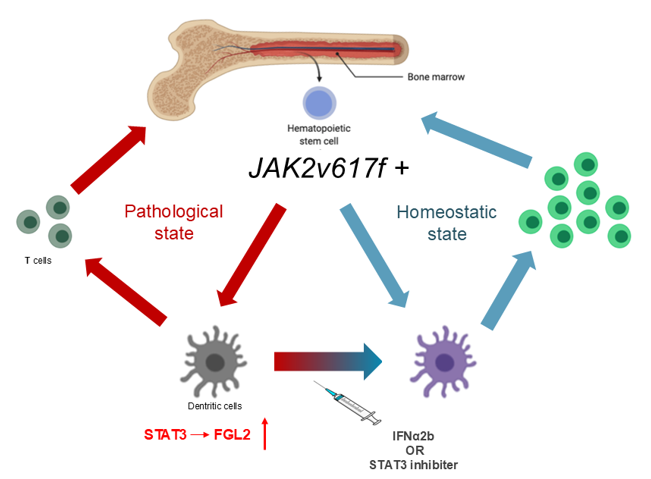
By integrating flow cytometry with single-cell RNA sequencing, the researchers generated a comprehensive immune landscape of patients with JAK2V617F-positive MPNs. Compared with patients with CALR-mutated or triple-negative MPNs, those with JAK2V617F-positive disease exhibited significantly reduced T-cell numbers and impaired proliferative capacity. This T-cell defect was not attributable to cellular senescence or exhaustion but was closely associated with reduced numbers and impaired function of dendritic cells (DCs).
Further analyses showed that DC maturation was impaired in patients with JAK2V617F-positive MPNs. Their antigen-presenting capacity and expression of costimulatory molecules were markedly reduced, resulting in defective DC-mediated T-cell activation and proliferation. Experiments using a CD11c-DTR mouse model confirmed that DC depletion could directly induce T-cell immune deficiency, reduce the number of tumor-specific T cells, and promote tumor growth. Moreover, patients with JAK2V617F-positive MPNs exhibited biased hematopoietic differentiation, characterized by a reduction in common dendritic cell progenitors (CDPs) in the bone marrow; marked decreases in pre-DCs, cDC1s, and cDC2s in peripheral blood; and an increased proportion of monocytes. Together, these alterations further reinforced the immunosuppressive state.
Mechanistic investigations identified STAT3 as a central transcription factor underlying DC dysfunction in JAK2V617F-positive MPNs. Integrated analyses using single-cell RNA sequencing, ATAC-seq, and CUT&Tag demonstrated that JAK2V617F led to sustained STAT3 activation in DCs and increased the expression of the immunosuppressive molecule FGL2. This established a STAT3–FGL2 regulatory axis that suppressed DC–T-cell interactions and weakened antitumor immune responses.
Notably, IFNα2b treatment significantly ameliorated these immune defects. It reduced STAT3 phosphorylation and FGL2 expression in DCs, promoted DC maturation, and restored the capacity of DCs to activate T cells. In vitro, STAT3 inhibition produced immunostimulatory effects similar to those of IFNα2b, while corresponding immunomodulatory effects were also observed in patients receiving IFNα2b treatment. These findings suggest that STAT3 is not only a key molecular target through which IFNα2b exerts its immunomodulatory effects but may also represent a promising target for precision therapy in JAK2V617F-positive MPNs.
In summary, this study provides the first systematic evidence that JAK2V617F suppresses antitumor immunity through STAT3-mediated dendritic cell dysfunction. It also reveals the mechanistic basis through which IFNα2b restores DC–T-cell immune function by modulating the STAT3–FGL2 pathway. These findings offer a new perspective on the immunopathogenesis of JAK2V617F-positive MPNs and provide a theoretical foundation for genotype-guided immunotherapeutic strategies, as well as combination therapies involving IFNα2b and STAT3-targeted agents.
Dr. Lei Zhang, Chief Physician at the Institute of Hematology & Blood Diseases Hospital, Chinese Academy of Medical Sciences & Peking Union Medical College, is the corresponding author. Dr. Lijun Fang, Attending Physician, and Dr. Rongfeng Fu, Associate Chief Physician, are co-first authors. The study was supported by the National Science and Technology Major Project, the National Natural Science Foundation of China, the CAMS Innovation Fund for Medical Sciences, and the Tianjin Science and Technology Program.
Original article: https://doi.org/10.1016/j.drup.2026.101352
Reference:
1. Vainchenker, W., and Kralovics, R. (2017). Genetic basis and molecular pathophysiology of classical myeloproliferative neoplasms. Blood129, 667-679.
2. Haage, T.R., Charakopoulos, E., Bhuria, V., Baldauf, C.K., Korthals, M., Handschuh, J., Müller, P., Li, J., Harit, K., Nishanth, G., et al. (2024). Neutrophil-specific expression of JAK2-V617F or CALRmut induces distinct inflammatory profiles in myeloproliferative neoplasia. Journal of Hematology & Oncology17, 43.
3. Strickland, M., Quek, L., and Psaila, B. (2022). The immune landscape in BCR-ABL negative myeloproliferative neoplasms: inflammation, infections and opportunities for immunotherapy. Br J Haematol196, 1149-1158.

