
Explore our diverse research areas, groundbreaking studies and remarkable medical research achievements
On March 4, 2026, a collaborative research team led by Guideng Li(Suzhou Institute of Systems Medicine, Chinese Academy of Medical Sciences), Hua Wu(Suzhou Medical College of Soochow University), and Lingchuan Guo(the First Affiliated Hospital of Soochow University) published a research article entitled “Extracellular CD44 lactylation impairs CD8⁺ T cell function in KRAS-mutant colorectal cancer” in Nature Metabolism. The study reveals a previously unrecognized mechanism by which KRAS-mutant colorectal cancer cells suppress T cell-mediated antitumor immunity through extracellular lactylation of CD44.
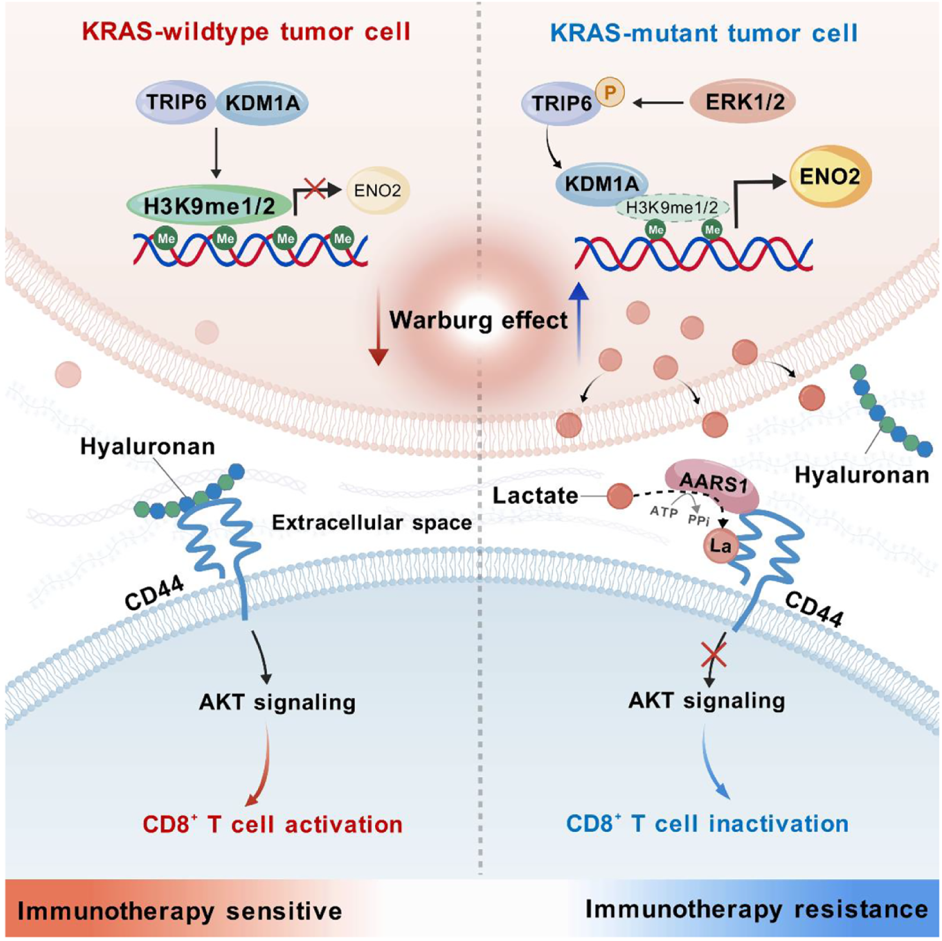
The authors demonstrated that KRAS mutations inducedERK1/2-dependent phosphorylation of TRIP6, thereby disrupting its interaction with KDM1A and consequentially upregulating ENO2 expression and lactate production. Tumor-derived lactate, together with the lactate-transfer enzyme AARS1, promoteslactylation of the extracellular domain of CD44 on CD8⁺ T cells. This modification weakened CD44 binding to hyaluronan and attenuated downstream AKT signaling, thereby impairing T cell antitumor activity. Notably, the study provides the first evidence that protein lactylation can occur extracellularly, thereby extending the established scope of this post-translational modification beyond intracellular compartments.
The authorsfurther developed PT6, a peptide inhibitor targeting TRIP6 phosphorylation. PT6 suppressedlactate production in KRAS-mutant colorectal cancer cells, diminishedCD44 lactylation, and restored antitumor function in CD8⁺ T cells. In mouse models, PT6 synergized with immune checkpoint blockade and CAR T cell therapy to enhance therapeutic efficacy.
Collectively, these findings delineate a KRAS mutation-driven CD44 lactylation that links tumor metabolic reprogramming to CD8+ T cell dysfunction.The study provides mechanisticinsight into immune evasion and resistance to immunotherapy in KRAS-mutant colorectal cancer, and identifiesTRIP6 phosphorylation as a therapeutically targetable node to enhance the efficacy of cancer immunotherapy.
Titles: Extracellular CD44 lactylation impairs CD8⁺ T cell function in KRAS-mutant colorectal cancer
Article type: Research articles
Published in: Nature Metabolism
Full-text links: https://www.nature.com/articles/s42255-026-01482-3

