
Explore our diverse research areas, groundbreaking studies and remarkable medical research achievements
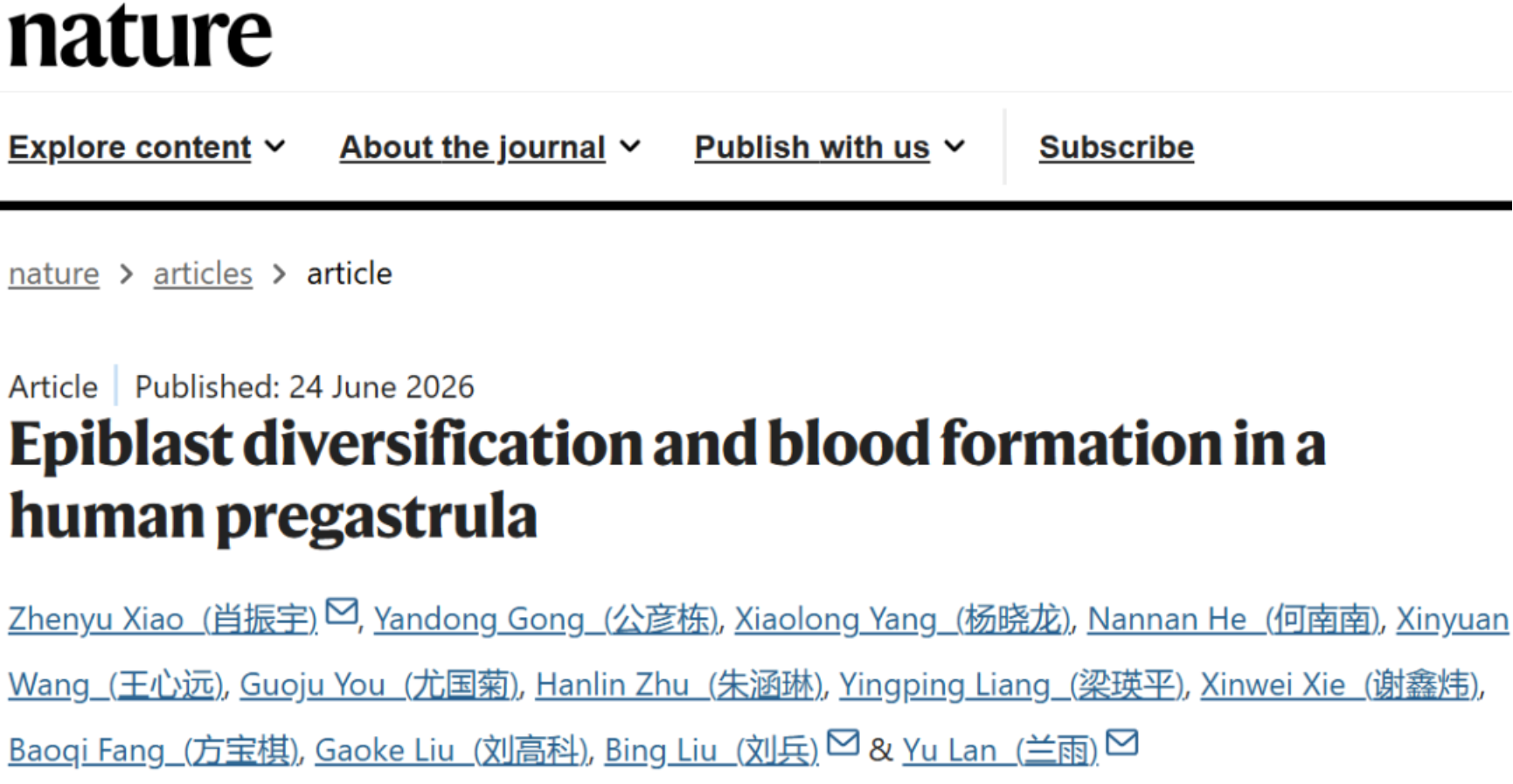
A new study, led by Prof. Yu Lan from the Institute of Hematology & Blood Diseases Hospital, Chinese Academy of Medical Sciences & Peking Union Medical College, in collaboration with Prof. Zhenyu Xiao from Beijing Institute of Technology and Prof. Bing Liu from the Chinese PLA General Hospital, and published in Nature, provides new insights into the emergence of the first blood cells during early human development, revealing that human primitive hematopoiesisinitiates prior to gastrulation and has a hypoblast origin,and that the early yolk sac contains differentregions that support the generation of distinctblood lineages.
Gastrulation is a pivotal stage of embryonic development during which the embryo transforms from a simple two-layered structure into a complex three-layered architecturethat later give rise to diverse tissues and organs. Blood cells are among the earliest cell types to emerge, and they have traditionally been thought to originate from the epiblast-derived mesoderm via gastrulation. However, the cellular origins and spatiotemporal onset of the first blood cells in humans remain elusive, given the limited availability of peri-gastrulation human embryos.
In this study, the researchers constructed a high-resolution spatial transcriptomic atlasof a precious human embryoat Carnegie stage 6 (CS6, approximately 13-14 days post-conception), a stage at which primitive streak remainsinvisible and gastrulation-derived mesodermal/endodermal progenitors are notyet transcriptomically detected. They identified a trifurcated epiblast trajectory toward the amnion, primitive streak, and axial mesoderm(node/prechordal plate/notochord), suggesting the pre-configured fate specificationat human gastrulation onset.
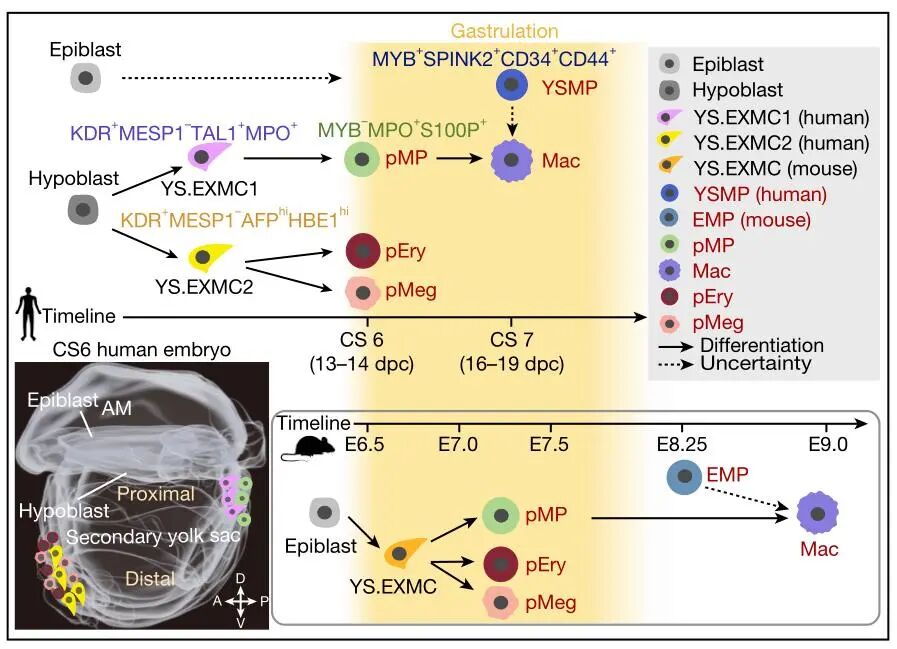
Moreover, the studyreveals that human primitive hematopoiesis begins earlier than previously thought—even before gastrulation onset—with the yolk sac already producing primitive erythrocytes, megakaryocytes, and myeloid progenitors. Importantly, the earliest human blood cells are not likely derived from the epiblast, as traditionally assumed, but instead from the extra‑embryonic mesoderm of hypoblast origin.This finding settles a long‑standing debate over the cellular origin of early human hematopoietic cells.
In addition, the early human yolk sac is not a functionally uniform hematopoietic site. It contains two spatial zones, each comprising molecularly distinct yolk sac endoderm and extra-embryonic mesoderm populations, that respectively facilitate the generation of erythro-megakaryocytic lineages and myeloid precursors. Specifically, environmental response-related pathwaysand EPO signaling are overrepresented in the yolk sac extra-embryonicmesoderm populationthat potentiallygives rise to erythro-megakaryocytic lineages.Furthermore, as the direct progeny of primitive myeloid precursorsfirst identified at CS6,the first primitive macrophages emerge in CS7 yolk sac and show atendency to specialize into microglia at their site of origin.
Taken together, the study not only reshapes the understanding of early human hematopoiesis but also provides physiological benchmarks and fresh conceptual insights for research such as de novo regeneration of blood cells in vitro and the study of early human developmental abnormalities.
This study was supported by the National Key Research and Development Program of China, the National Natural Science Foundation of China, the Chinese Academy of Medical Sciences Innovation Fund for Medical Sciences, and the Innovation Fund of the Haihe Laboratory of Cell Ecosystem. Yu Lan,Zhenyu Xiao and Bing Liuserved as co-corresponding authors. Zhenyu Xiao, Yandong Gong, Xiaolong Yang, and Nannan He contributed equally as co-first authors.
Link: https://www.nature.com/articles/s41586-026-10698-y

