
Explore our diverse research areas, groundbreaking studies and remarkable medical research achievements
Source: National Clinical Research Center for Cardiovascular Diseases · Beijing · 6 August 2026
Originally published by the Structural Heart Disease Center, Fuwai Hospital
Original URL: https://mp.weixin.qq.com/s/bntJx7B8uEdyWbw-iJwK5A
From a "Treatment Dilemma" to a "China Solution"
— The COMPETE trial by Professor Pan Xiangbin's team at Fuwai Hospital is published in the top-tier journal The British Medical Journal, exploring a new treatment strategy for migraine associated with patent foramen ovale
Migraine is a long-standing complaint that many people cannot shake off.
That sudden, severe headache — accompanied by nausea, sensitivity to light and sensitivity to sound — often makes it impossible to work or live normally. Statistically, about 1 billion people worldwide are affected by migraine, and it is the third most common disease in the world.
What many people may not know is that inside the bodies of many migraine patients there is an easily overlooked "channel" — the patent foramen ovale (PFO).
This "small gap" in the heart may be the instigator of migraine. Yet for many years the treatment of PFO-associated migraine has remained a clinical challenge: Which patients' migraines are actually related to PFO? Is antithrombotic therapy useful? What kind of patient is suitable for closure surgery? These questions have long troubled both clinicians and patients.
Recently, the COMPETE trial (Comparison of the Effect of Medication in Alleviating Migraine with Patent Foramen Ovale), led by the research team of Professor Pan Xiangbin — Principal Investigator at the National Clinical Research Center for Cardiovascular Diseases, Fuwai Hospital, Chinese Academy of Medical Sciences — was formally published in the top international medical journal The BMJ (The BMJ, 2026;394:e100103). Addressing the clinical challenge of PFO-associated migraine, the study systematically evaluated the efficacy and safety of different antithrombotic treatment strategies through a large-scale randomized controlled trial. It found that rivaroxaban offers better efficacy, providing important clinical evidence for formulating treatment strategies for PFO-associated migraine.
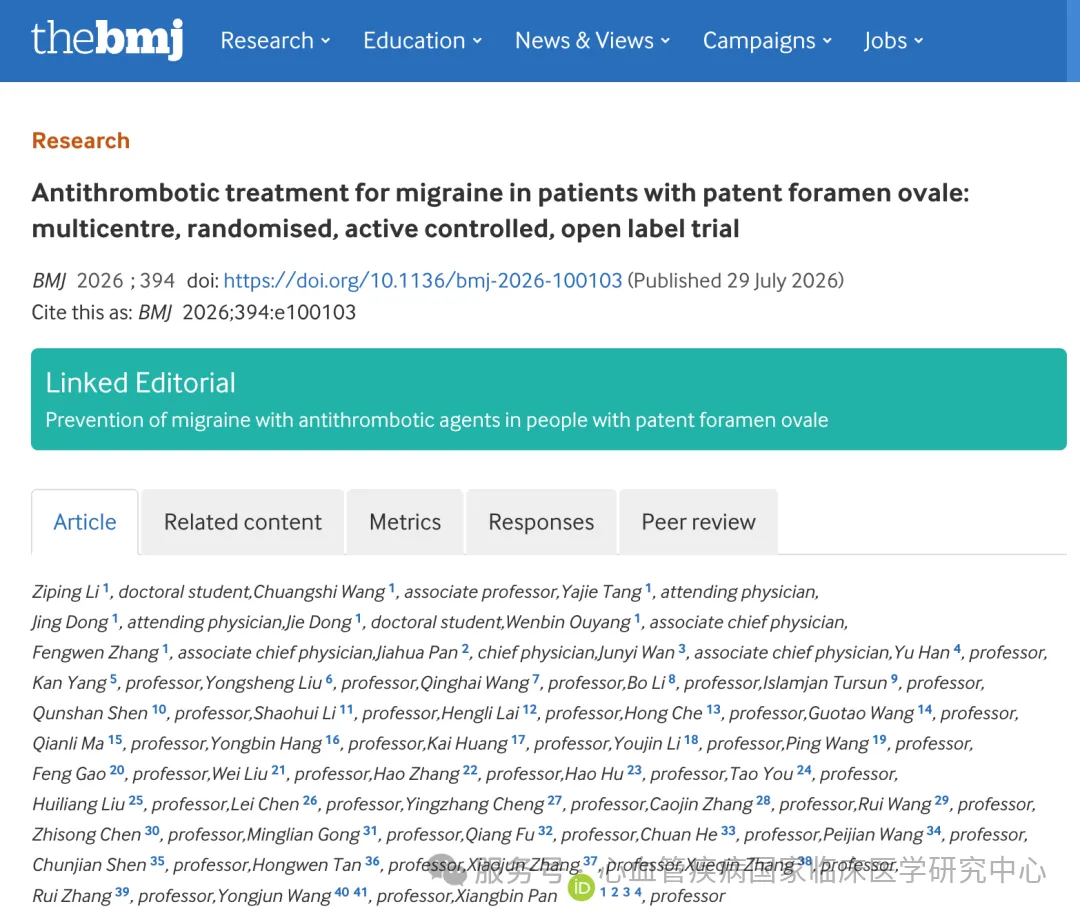
The COMPETE paper as published on The BMJ website (image in original Chinese-language article): "Antithrombotic treatment for migraine in patients with patent foramen ovale: multicentre, randomised, active controlled, open label trial", BMJ 2026;394:e100103, published 29 July 2026
In the same issue, The BMJ invited Professor Gretchen E. Tietjen, an internationally renowned expert in migraine and cerebrovascular disease, to publish a dedicated editorial (The BMJ, 2026;394:e100359) offering an in-depth interpretation of the COMPETE trial. The editorial notes that the study provides clinical insight into migraine treatment strategies, advances understanding of the potential mechanisms underlying PFO-associated migraine, and points to important directions for identifying patients who may benefit from PFO closure and for optimizing treatment strategies in the future.
An Overlooked Connection: The "Small Gap" in the Heart and Migraine
To understand the significance of this study, we first need to be clear about the relationship between PFO and migraine.
Patent foramen ovale (PFO) is, simply put, a "small passage" in the atrial septum of the heart that has not completely closed after birth. During fetal life, the foramen ovale is an important channel for blood circulation, and it usually closes gradually after birth. However, in about 25% of adults this passage has not fully healed over, leaving a "small gap" — that is the PFO. In most cases a PFO causes no symptoms at all. But a growing body of research in recent years has found that the proportion of people with PFO is significantly higher among migraine patients than in the general population.
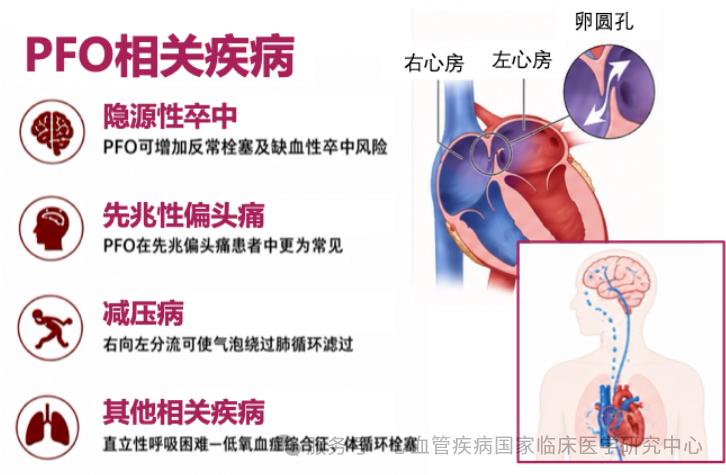
Original Chinese figure — "Conditions associated with PFO": cryptogenic stroke (PFO can increase the risk of paradoxical embolism and ischaemic stroke); migraine with aura (PFO is more common in patients with aura); decompression sickness (a right-to-left shunt lets gas bubbles bypass filtration by the pulmonary circulation); other associated conditions (platypnoea-orthodeoxia syndrome, systemic embolism)
Why would a gap in the heart have anything to do with headaches? The "microembolism hypothesis" holds that a PFO may cause a right-to-left shunt in the atria, allowing microemboli in the venous system to bypass filtration by the lungs and enter the cerebral circulation directly, triggering related neural mechanisms and thereby contributing to the occurrence of migraine.
This sounds plausible, but one prominent clinical difficulty in treating migraine is that treatment effects vary enormously from patient to patient: with the same drug or the same operation, some people improve markedly while others see limited benefit. For migraine patients who also have a PFO, several key questions remain to be answered: Is antithrombotic therapy really effective? Which patients can genuinely benefit from PFO closure? Can the response to drug therapy serve as a clue for screening the population most likely to benefit from closure? These questions directly affect whether patients can receive more precise and appropriate treatment.
It is precisely around these clinical pain points that Professor Pan Xiangbin's team carried out clinical research in three different phases, systematically exploring treatment strategies and precision management methods for patients with PFO-associated migraine.
The COMPETE Trial: A Multicenter Randomized Controlled Study Built on a Mechanistic Hypothesis
COMPETE is an investigator-initiated, multicenter, randomized controlled clinical trial led by Fuwai Hospital, Chinese Academy of Medical Sciences, conducted at 39 centers nationwide and enrolling a total of 1,000 patients with PFO-associated migraine. It is one of the larger prospective randomized controlled studies in this field to date.
The study set out to evaluate whether antithrombotic therapy can relieve PFO-associated migraine. Using metoprolol, a conventional migraine-prevention drug, as the control, it compared the efficacy and safety of aspirin, clopidogrel and the novel oral anticoagulant rivaroxaban in patients with PFO-associated migraine. The study also explored the effects of the study drugs in subgroups with different clinical characteristics, including patients with and without aura and patients with small, moderate or large right-to-left shunts, providing a basis for future patient stratification and individualized treatment. The primary endpoint was the response rate of the drugs for migraine in PFO patients, defined as the proportion of patients whose mean number of migraine days or migraine attacks had fallen by at least 50% from baseline after 12 weeks of treatment.
The results showed a response rate of 61.7% for aspirin, 66.8% for clopidogrel and 78.4% for rivaroxaban, versus 61.8% for metoprolol in the control group. The response rates for aspirin, clopidogrel and rivaroxaban were all non-inferior to metoprolol, and the response rate for rivaroxaban was significantly higher than that for metoprolol. The efficacy advantage of rivaroxaban over metoprolol was broadly consistent across subgroups and was particularly pronounced in patients with migraine with aura and in patients with grade 3 right-to-left shunt (RLS).
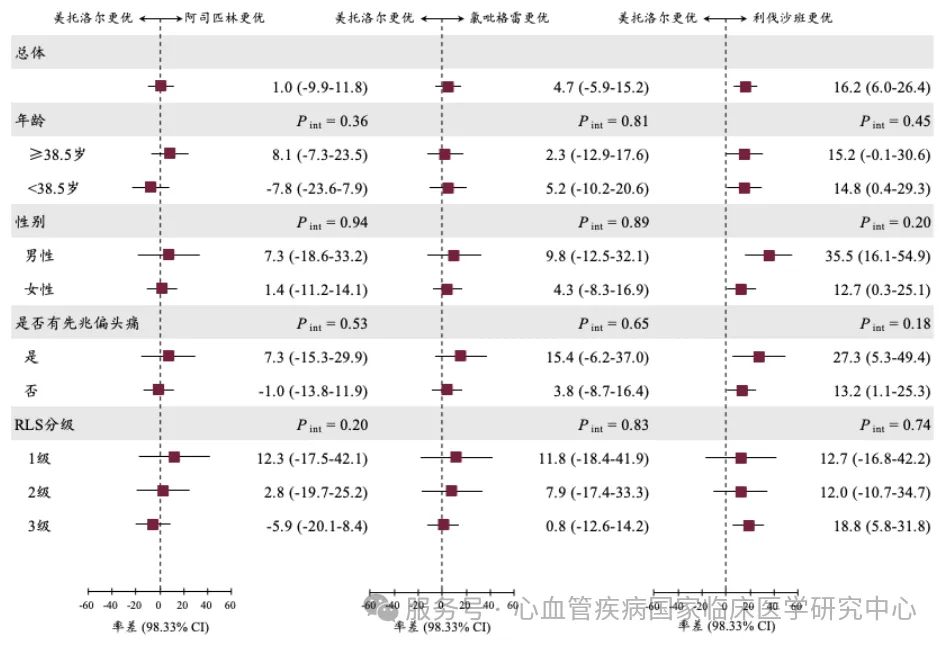
Original Chinese figure — subgroup forest plot of the rate difference (98.33% CI) for aspirin, clopidogrel and rivaroxaban versus metoprolol. Rows, top to bottom: overall; age (≥38.5 years / <38.5 years); sex (male / female); migraine with aura (yes / no); RLS grade (1 / 2 / 3). Left of the dashed line favours metoprolol, right favours the study drug
The study suggests that there may be a disease mechanism related to microembolism that gives rise to PFO-associated migraine, and that the response to antithrombotic therapy may become an important clue for identifying, in the future, the population that would benefit from closure.
And There Is More — A Tightly Linked, Three-Phase Research Programme to Systematically Tackle a Clinical Challenge
Around this patient population with PFO-associated migraine, Professor Pan Xiangbin's team has planned a three-phase series of studies, progressing step by step from drug therapy to precise patient screening and then to device innovation:
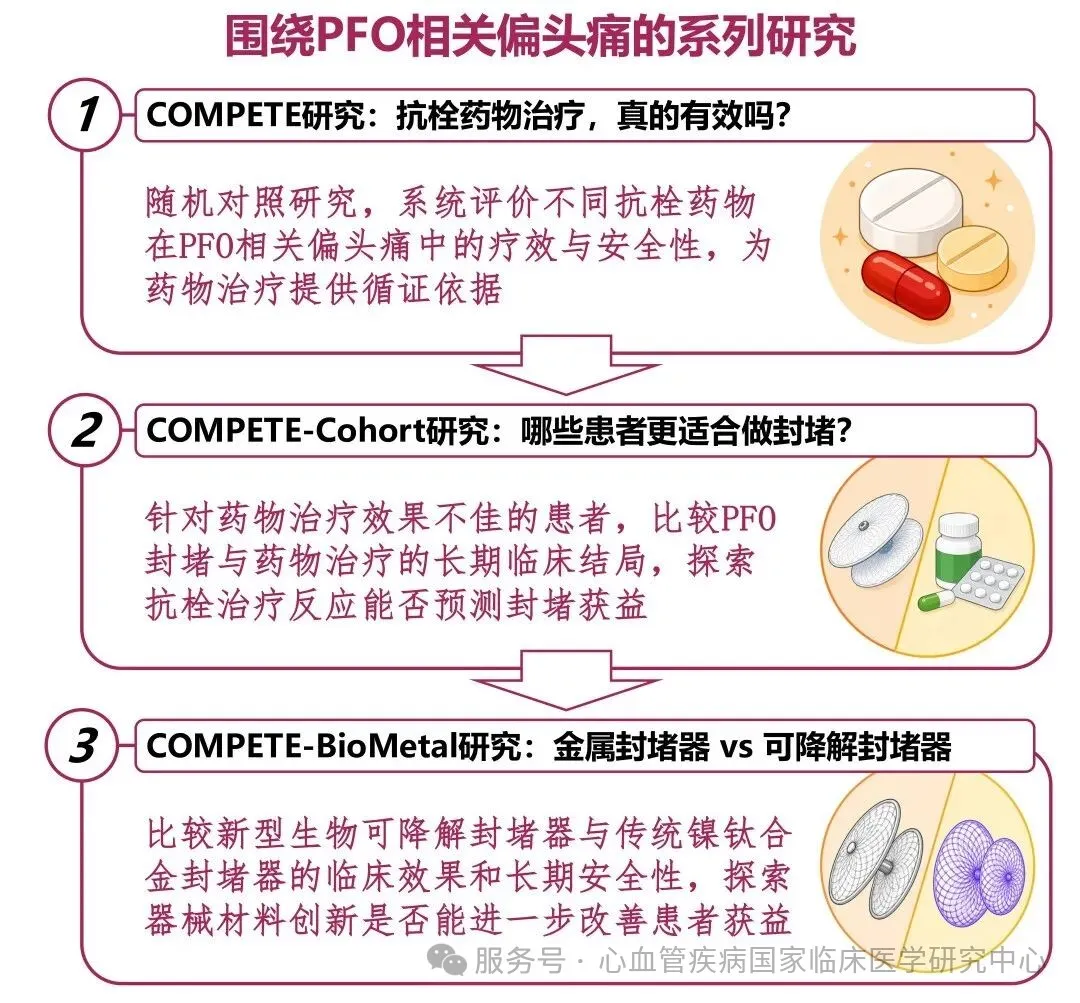
Original Chinese figure — "A series of studies on PFO-associated migraine": (1) COMPETE — is antithrombotic drug therapy really effective? (2) COMPETE-Cohort — which patients are better suited to closure? (3) COMPETE-BioMetal — metal occluder versus degradable occluder
(1) Phase one is the randomized controlled trial now published in The BMJ, which systematically evaluates the efficacy and safety of antithrombotic therapy in PFO-associated migraine and provides evidence-based support for drug treatment.
(2) Phase two is the COMPETE-Cohort study, which targets patients with PFO-associated migraine with aura who respond poorly to drug therapy. It compares long-term clinical outcomes after PFO closure versus drug therapy, with a focus on exploring whether the response to antithrombotic therapy can serve as a functional marker predicting benefit from PFO closure. In plain terms: using a patient's response to antithrombotic therapy to judge who is more suitable for closure surgery. This will provide a key basis for optimizing patient selection and treatment decisions in the future.
(3) Phase three is the COMPETE-BioMetal study, which evaluates the clinical outcomes and long-term safety of a new biodegradable PFO occluder compared with a conventional nickel-titanium alloy occluder in patients with PFO-associated migraine, exploring whether innovation in device materials can further improve patient benefit. Why pursue a degradable occluder? Conventional PFO occluders generally use permanent materials such as nickel-titanium alloy. Although these are already widely used in clinical practice, issues arising from permanently implanted materials — arrhythmia, thrombus, nickel-related delayed hypersensitivity reactions and chronic aseptic inflammation — still warrant further exploration. To address these problems, Professor Pan Xiangbin's team has continued to advance research on innovative PFO closure devices, exploring the concept of using new materials to achieve "intervention without implantation, implantation without residue." The market-approval study of this product has already been published in Circulation, the authoritative international journal in the cardiovascular field, and the newly launched study will provide an important basis for formulating treatment strategies involving absorbable occluders and migraine.
Through these three linked studies, Professor Pan Xiangbin's team has conducted in-depth research on PFO-associated migraine at three levels — exploration of pathogenic mechanisms, precise patient screening and innovation in closure devices — continuously driving the accumulation of clinical evidence and the optimization of treatment strategies in this field.
Bringing China's Original Clinical Research onto the International Stage
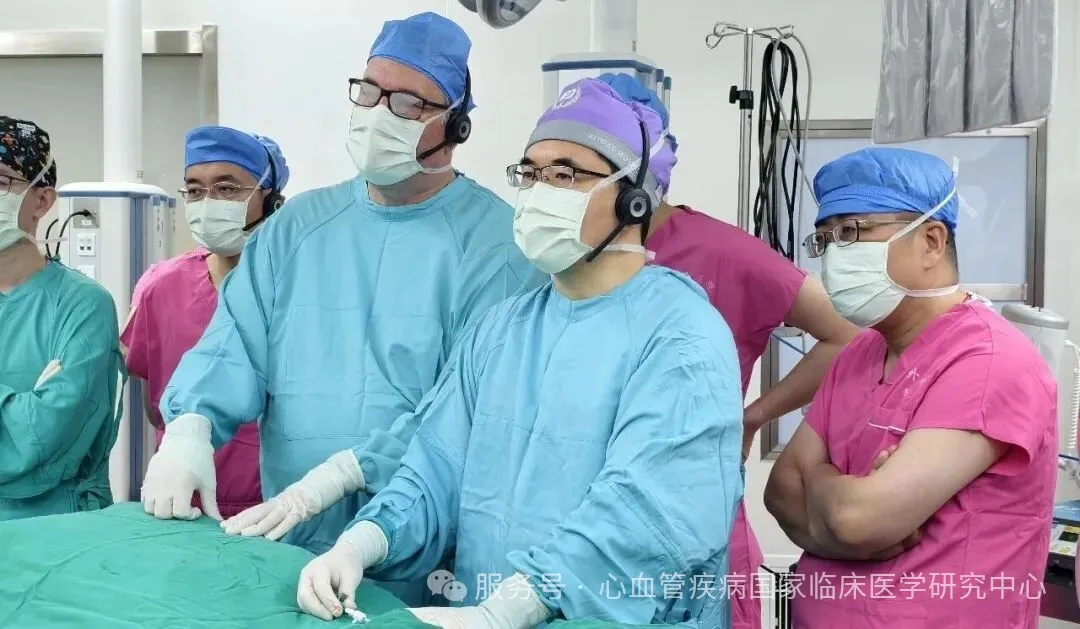
Professor Pan Xiangbin’s team performing an ultrasound-guided interventional procedure (image from the original article)
Underpinning this series of original clinical studies is the ultrasound-guided interventional technique invented by Professor Pan Xiangbin's team at Fuwai Hospital. The technique has opened a new era of radiation-free percutaneous interventional treatment: with an ultrasound machine no bigger than a laptop, cardiac surgery can be performed, achieving treatment of heart disease "without opening the chest, without radiation, without contrast agent, and even with the patient fully awake." It not only eliminates iatrogenic injury caused by radiation and contrast agents and rewrites surgical contraindications — allowing high-risk patients such as the elderly, cancer patients, pregnant women and infants to receive effective treatment — but also markedly improves the accessibility of medical services: cardiac surgery has gone from being a "major operation" requiring a trip to a big city and a leading surgeon at a major hospital to an "outpatient procedure" or even a "doorstep procedure," reaching world-leading levels in safety, efficacy and accessibility simultaneously.
From the COMPETE trial exploring the effect of antithrombotic therapy in PFO-associated migraine, to the COMPETE-Cohort study further seeking the subgroups likely to benefit from PFO closure, and on to the COMPETE-BioMetal study exploring degradable closure device technology, Professor Pan Xiangbin's team continues to conduct high-quality clinical research centered on the clinical treatment needs of PFO-associated migraine. Looking ahead, the team will continue to build on the advantages of its original ultrasound-guided interventional technology system, carrying out high-level clinical research in structural heart disease, cardio-cerebral comorbidity and precision treatment, bringing more original Chinese evidence to the international stage and providing patients with more precise, safe and effective treatment options.
Source: Structural Heart Disease Center, Fuwai Hospital
Note on names: in the BMJ paper the corresponding author is listed in Western name order as Xiangbin Pan (潘湘斌).

