
Explore our diverse research areas, groundbreaking studies and remarkable medical research achievements
On June 9, 2026, the research team led by Professor Wang Jing from the Institute of Basic Medical Sciences, Chinese Academy of Medical Sciences, published a paper inCirculationtitled "Alternative splicing of TPM1 mediated by SRPK3 drives cardiac diastolic dysfunction in heart failure with preserved ejection fraction." The study reports that alternative splicing of TPM1 exon 9a is a key pathogenic mechanism underlying myofilament disarray and diastolic dysfunction in HFpEF, and this process depends on the upstream splicing kinase SRPK3. SRPK3 may represent a novel therapeutic target for HFpEF.
Heart failure is the end-stage manifestation of various cardiac diseases, and its morbidity and mortality remain persistently high. Among these, heart failure with preserved ejection fraction accounts for approximately 50% of all heart failure cases. The pathological mechanisms of HFpEF are complex, and existing therapeutic strategies for heart failure with reduced ejection fraction (HFrEF) show limited efficacy in HFpEF patients. Therefore, it is of critical importance to deeply dissect the molecular mechanisms of HFpEF and explore novel therapeutic approaches.
Professor Wang Jing's team discovered unique myofibrillar structural disarray in the ventricular myocardium of HFpEF patients and mouse models. By analyzing RNA‑seq data from public databases, the researchers found that TPM1 exon 9a undergoes skipping (i.e., upregulation of the TPM1b isoform) in HFpEF hearts, and this change was validated in both HFpEF patients and mouse hearts. Furthermore, using human pluripotent stem cell‑derived cardiomyocytes (hPSC‑CMs) stimulated with high glucose plus palmitic acid (to mimic HFpEF), they observed myofibrillar disarray, slowed relaxation velocity, reduced compliance (with nanoindentation showing increased Young's modulus and impaired stress relaxation), and elevated TPM1b protein levels.
In vitro and in vivo experiments confirmed that TPM1b impairs cardiomyocyte diastolic function, increases Young's modulus (reduces compliance), while TPM1a improves diastolic dysfunction. At the skinned myofiber level, TPM1b causes myofilament disarray, elevated passive tension, and impaired stress relaxation. At the thin filament level, TPM1b exhibits weaker binding affinity to F‑actin and significantly reduces its persistence length (i.e., decreased bending stiffness and increased flexibility). Collectively, TPM1b is a pathogenic splicing isoform that drives diastolic dysfunction in HFpEF by disrupting myofilament assembly and thin‑filament mechanical properties.
Mechanistically, Professor Wang Jing's team found that SRPK3 (cardiac‑specifically expressed)‑mediated phosphorylation of SRSF1 promotes TPM1 splicing. Subsequently, using SRPK3 overexpression/knockdown adenoviruses and SRPK inhibitor interventions in HFpEF mice and hPSC‑CMs, they confirmed that SRPK3 mediates aberrant TPM1 splicing leading to diastolic dysfunction, and SRPK3 may serve as a novel therapeutic target for HFpEF.
In summary, this study identifies that SRPK3‑mediated alternative splicing of TPM1 exon 9a and the consequent myofilament structural disarray and reduced compliance are critical pathogenic factors in HFpEF progression. This work not only reveals new roles for different TPM1 isoforms and SRPK3 in HFpEF but also suggests that targeting SRPK3 may provide a new strategy for HFpEF therapy.
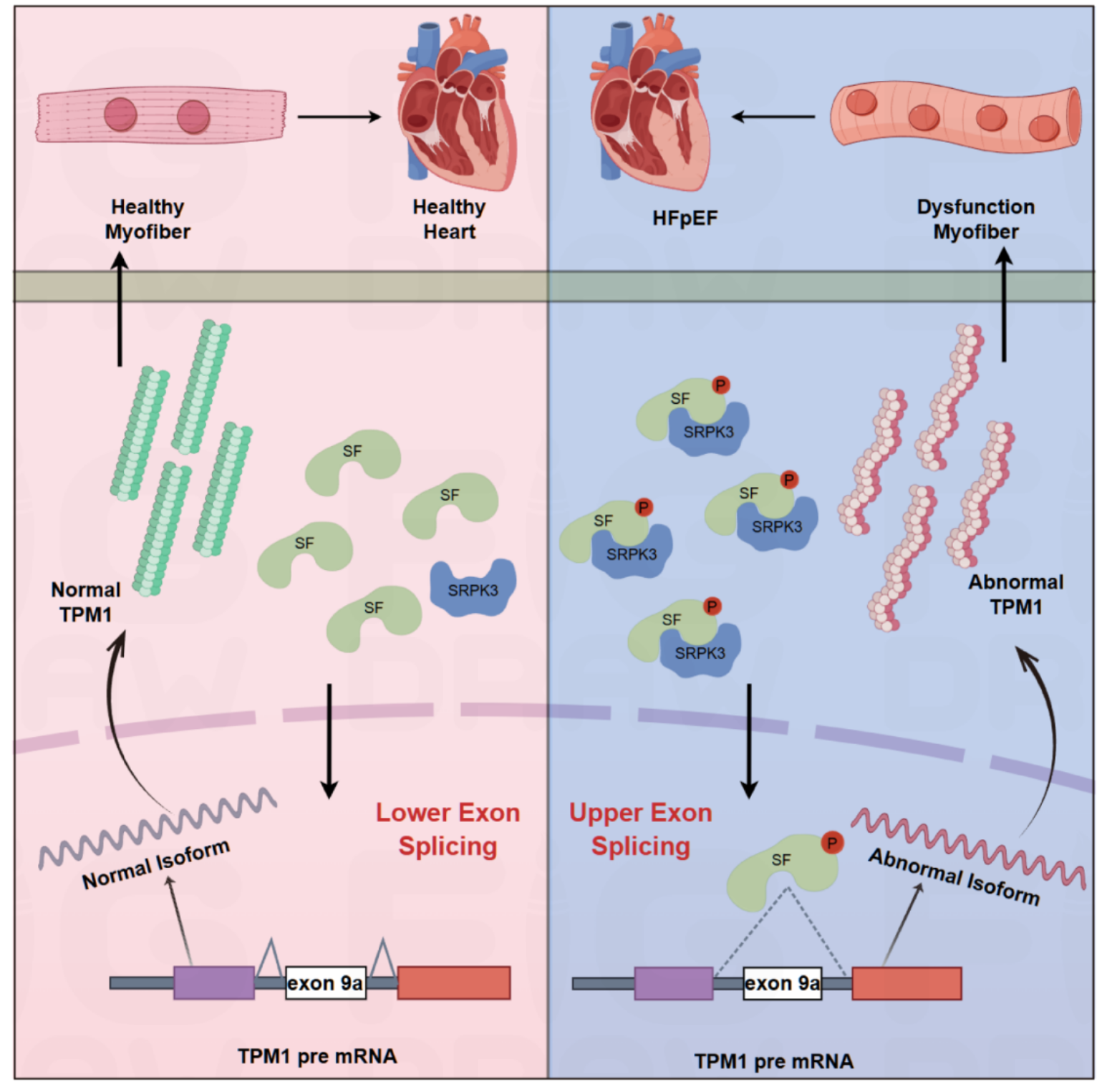
Figure. Key pathogenic factors in HFpEF progression: SRPK3-mediated alternative splicing of TPM1 exon 9a, myofibrillar disarray, and reduced compliance.
This work was supported by the Chinese Academy of Medical Sciences (CAMS) Innovation Fund for Medical Sciences (CIFMS 2025-I2M-XHJC-022) and other funding sources. Professor Wang Jing from the Institute of Basic Medical Sciences and Professor Jiang Wenjian from Beijing Anzhen Hospital, Capital Medical University, are the co-corresponding authors. Chen Qian, Wang Xiaoping from the Institute of Basic Medical Sciences, and Yin Ziyi from Changping Laboratory are the co-first authors of this article.
Paper link: https://www.ahajournals.org/doi/full/10.1161/CIRCULATIONAHA.125.079124
Institute of Basic Medical Sciences

