
Explore our diverse research areas, groundbreaking studies and remarkable medical research achievements
Liver injury is a major complication of severe dengue, yet its pathological evolution and key molecular features remain to be systematically elucidated. On July 16, 2026, a research team led by Professor Wei Wang from the Institute of Laboratory Animal Sciences, Chinese Academy of Medical Sciences, in collaboration with Professor Juntao Yang from the Institute of Basic Medical Sciences, Chinese Academy of Medical Sciences, published a paper in Journal of Hepatology (IF = 40.1) entitled "Disruption of carbon metabolism by the hepatic mononuclear phagocytic system drives liver injury in a mouse model of severe dengue". By integrating multi-omics and single-cell RNA sequencing, the study systematically mapped the dynamic hepatic molecular landscape in a mouse model of severe dengue, and demonstrated that fostamatinib, an already marketed drug, significantly alleviates liver injury, offering a new strategy and direction for clinical intervention in severe dengue.
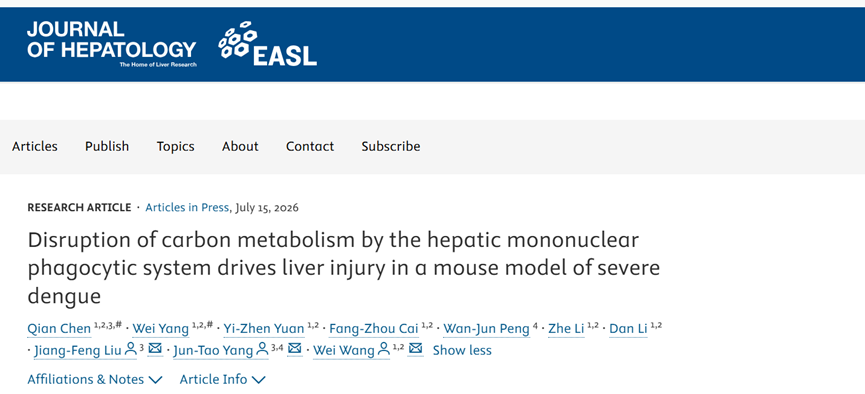
Dengue fever is an acute infectious disease caused by dengue virus and transmitted by mosquito vectors. WHO estimates that approximately 3.9 billion people worldwide are at risk of infection. In recent years, dengue outbreaks have continued to spread, with a growing disease burden. Liver injury is one of the most common complications of severe dengue, clinically manifested primarily by marked elevations in serum transaminases (AST/ALT), and may progress to liver failure; histopathological examination reveals hepatic congestion, swelling, steatosis, and necrosis. However, the dynamic pathological progression and key molecular features remain to be systematically characterized.
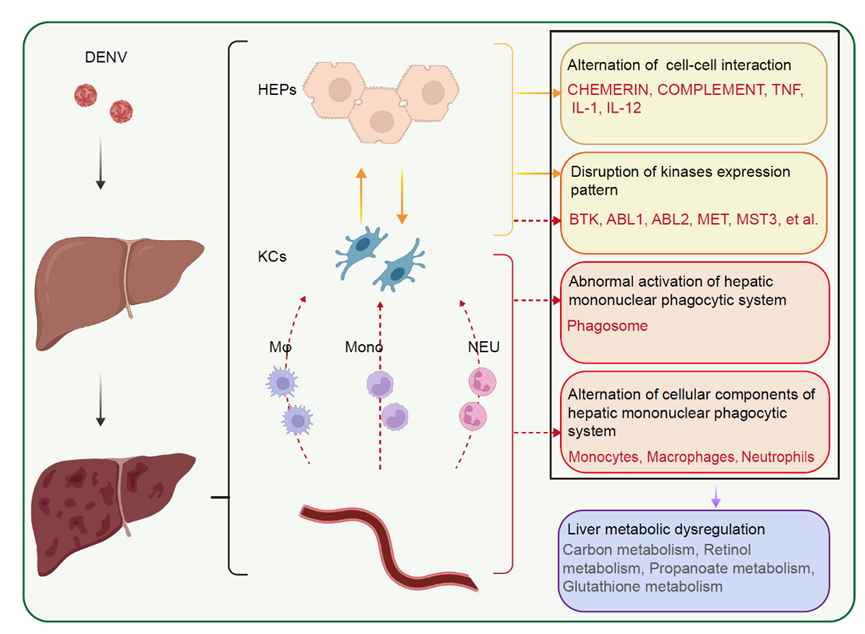
The research team established a severe dengue model using IFNAR1 knockout mice and performed integrative analysis of the liver transcriptome, proteome, phosphoproteome, and single-cell transcriptome on days 2, 4, and 6 post-infection. The results showed that multiple key carbon metabolic pathways were significantly downregulated in the livers of model mice, indicating severe impairment of hepatic energy supply and biosynthetic functions. Single-cell transcriptomics further revealed a marked reduction in hepatocyte numbers, whereas the hepatic mononuclear phagocytic system (including resident Kupffer cells and infiltrating monocytes/macrophages) was significantly expanded. Meanwhile, intercellular communication networks between hepatocytes and these immune cells underwent systematic remodeling, with aberrant activation of pro-inflammatory signaling pathways such as TNF, IL-1, and IL-12, which in turn mediated hepatic carbon metabolic disturbances.
Further investigation revealed aberrant changes in the activity of multiple kinases in the livers of severe dengue mice, among which BTK kinase expression levels were positively correlated with the intrahepatic expansion of mononuclear phagocytic cells, with both increasing synchronously. Protein–protein interaction network analysis showed that fostamatinib, an FDA-approved small-molecule tyrosine kinase inhibitor, targets multiple kinases situated at key nodes of the immune signaling regulatory network. In vivo experiments demonstrated that fostamatinib significantly restored hepatic carbon metabolic function, attenuated inflammatory responses and pathological damage, and prolonged survival in severe dengue mice.
By integrating multi-omics and single-cell sequencing, this study constructed a dynamic multi-omics integrative network atlas, elucidating the "immune activation–metabolic disorder" core regulatory axis in severe dengue‑associated liver injury, and revealing that aberrant intercellular communication between hepatocytes and the hepatic immune system is a key mechanism driving liver injury in severe dengue. Furthermore, the study found that fostamatinib, an already clinically approved drug, exerts dual effects of anti‑inflammation and metabolic restoration, providing novel theoretical basis and potential therapeutic strategy for the prevention and treatment of liver injury in severe dengue.
Professor Wei Wang (Institute of Laboratory Animal Sciences, Chinese Academy of Medical Sciences), Professor Juntao Yang, and Associate Research Fellow Jiangfeng Liu (Institute of Basic Medical Sciences, Chinese Academy of Medical Sciences) are co-corresponding authors. Dr. Qian Chen and Dr. Wei Yang are co-first authors. This work was supported by the Chinese Academy of Medical Sciences (CAMS) Innovation Fund for Medical Sciences, the National Natural Science Foundation of China, and the National Key Research and Development Program of China.

